White hexagon tile is one of the most distinctive and enduring patterns in residential design. The six-sided shape has been used in floors and walls since the Victorian era, and it remains just as relevant today, showing up in everything from sleek contemporary bathrooms to charming farmhouse kitchens. The difference between those looks is entirely in how the tile is scaled, finished, grouted, and combined with surrounding materials.
This guide covers everything you need to know about using white hexagon tile: where it works best, which size to choose, how to handle grout, and how to style it with the rest of your space. Browse our full white tile collection or go directly to our hexagon tile collection.
Why White Hexagon Tile Has Never Gone Out of Style
The hexagon is mathematically perfect, a six-sided polygon that tiles a flat plane without gaps, creating a pattern with natural visual rhythm. Unlike square or rectangular tile, which can read as static and grid-like, hexagon tile has an organic quality that makes it feel less rigid and more interesting.
White hexagon tile in particular works because it delivers visual interest through shape rather than color. You get a pattern that has character and depth without introducing anything that could clash with other design elements or date the space. The result is a floor or wall that reads as designed and intentional while staying firmly in a neutral palette.
White Hexagon Tile Sizes
1-Inch White Hexagon Mosaic
The smallest common hexagon format, typically sold mesh-mounted in 12x12-inch sheets. This is the most traditional size, the one you find in Victorian-era bathrooms and classic penny tile floors. The fine-grained pattern and high density of grout lines create a beautifully textured surface that works particularly well on shower floors and small bathroom floors.
2-Inch White Hexagon Mosaic
Slightly larger than the classic 1-inch, but still mesh-mounted. A popular middle ground that gives more visual weight to each individual tile while retaining the mosaic-like quality. Works well on floors and walls, especially in mid-sized bathrooms.
4-Inch White Hexagon Tile
A larger format that reads more like individual tiles than a mosaic. The 4-inch hexagon works well on bathroom floors, kitchen floors, and bathroom walls where you want the hexagon shape to be clearly visible and prominent. More graphic and bold than the smaller mosaic formats.
6-Inch and Larger White Hexagon Tile
Large-format hexagon tile makes a strong statement on floors and walls. The individual tiles are clearly visible, and the hexagonal grid becomes a prominent design feature. Very popular in contemporary and modern spaces. Works best in larger rooms where the scale of the tile is appropriate.
Where to Use White Hexagon Tile
White Hexagon Tile on Bathroom Floors
This is the most classic application for white hexagon tile, and it remains one of the most popular bathroom floor looks in residential design. A field of 1-inch or 2-inch white hexagon mosaic on a bathroom floor, grouted in charcoal or dark gray, creates a vintage-inspired look with tremendous character. Grouted in white or light gray, the same tile creates a cleaner, more contemporary result.
White hexagon tile on a bathroom floor pairs beautifully with almost any wall tile choice. White subway tile walls create a cohesive all-white bathroom with textural contrast between the wall and floor. A more colorful wall tile gives the white hexagon floor a neutral grounding role.
For complete bathroom inspiration, see our guide to white bathroom tile ideas.
White Hexagon Tile on Shower Floors
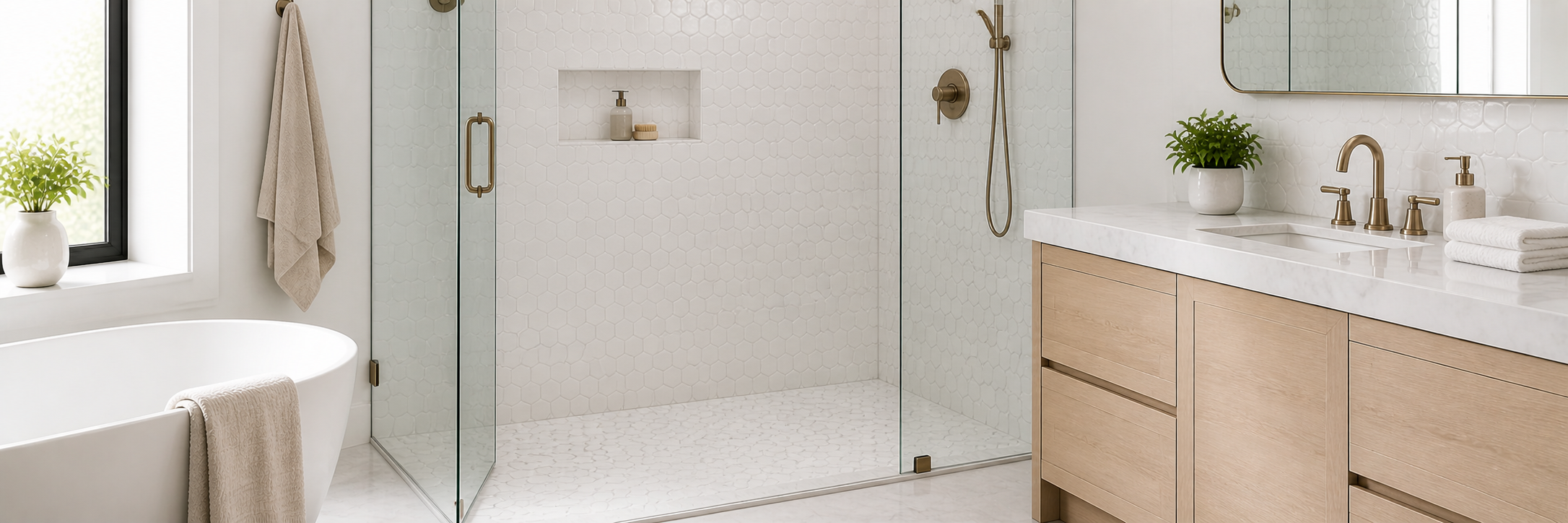
White hexagon mosaic tile is one of the top recommendations for shower floors. The reasons are both aesthetic and practical. Aesthetically, the small mosaic format adds visual interest underfoot without overwhelming the shower. Practically, the high density of grout lines in a mosaic installation creates excellent traction, far more grip than a single large smooth tile. The small tile format also conforms more easily to the slight slope of a shower pan, which promotes proper drainage.
For shower floor applications, choose a white hexagon tile in a matte or textured finish rather than a high-gloss surface. A 1-inch or 2-inch hexagon is the most common shower floor size. For complete ideas, see our guide to white tile shower ideas.
White Hexagon Tile on Bathroom Walls
While hexagon tile is most commonly used on floors, it works beautifully on bathroom walls as well, especially as an accent or feature application. A field of small white hexagon mosaic on the wall behind the vanity creates a subtle, textured backdrop that is more interesting than flat subway tile without overwhelming the space. Larger 4-inch or 6-inch white hexagon tile on a bathroom wall makes a more graphic, contemporary statement.
White Hexagon Tile as a Kitchen Backsplash
White hexagon mosaic tile makes a distinctive kitchen backsplash, particularly the 1-inch or 2-inch mesh-mounted format. It creates a more textured, interesting surface than a standard subway tile while staying firmly in a white, neutral palette. It pairs particularly well with wood-tone cabinetry, marble or quartz countertops, and brass or matte black fixtures.
White Hexagon Tile on Entryway Floors
A white hexagon tile entryway floor is a classic design move that immediately elevates the entrance of a home. The pattern is distinctive enough to be the focal point of the space. Use a black or dark charcoal grout for a bold, graphic result reminiscent of Victorian and early-twentieth-century design, or white grout for a cleaner contemporary take.
Grout Color for White Hexagon Tile
Grout choice more dramatically affects hexagon tile than almost any other format, simply because there are so many grout lines relative to the tile surface area. Here are your main options:
White Grout with White Hexagon Tile
Creates a seamless, unified surface. The hexagonal pattern is subtle, you can see the shape, but the overall effect is a clean white surface with texture. This is the most contemporary approach and works well in modern spaces.
Light Gray Grout with White Hexagon Tile
Defines each tile clearly without harsh contrast. The most popular everyday choice, the hexagonal pattern is visible and attractive, and the overall palette stays light and neutral.
Charcoal or Dark Gray Grout with White Hexagon Tile
Creates the most dramatic contrast and the most clearly defined hexagonal pattern. This is the classic Victorian-era look that has never gone out of style. The white tile and dark grout together have a graphic, high-contrast quality that is instantly recognizable and genuinely timeless.
Black Grout with White Hexagon Tile
The most dramatic option. Works best in bathrooms with a deliberate black-and-white design scheme. The result is bold and graphic, be sure it suits your overall aesthetic before committing.
For a complete guide to grout decisions for all white tile, see our post on the best grout color for white tile.
How to Keep White Hexagon Tile Looking Clean
The primary maintenance challenge with white hexagon tile is the grout, specifically if you have chosen a light grout color with a high density of grout lines. Seal your grout immediately after installation and re-seal annually. Use a pH-neutral tile cleaner for regular cleaning, and a grout-specific cleaner for periodic deep cleaning of the grout lines. For detailed instructions, see our complete guide on how to clean white tile.
The tile surface itself is very easy to clean. Ceramic and porcelain hexagon tile wipes clean with a damp cloth.
White Hexagon Tile vs. White Penny Round Tile
White hexagon and white penny round (circular mosaic) are the two most popular small-format white mosaic tile options for floors and shower floors. For a full comparison of all white mosaic materials and shapes, including glass, porcelain, ceramic, arabesque, and mini brick, see our complete white mosaic tile guide. Here is how hexagon and penny round specifically differ:
- Shape: Hexagon has six sides and creates a geometric grid. Penny round is circular and creates a more organic, softer pattern.
- Grout lines: Penny round has slightly more curved grout lines, which some people find more visually interesting. Hexagon grout lines are straight.
- Style: White hexagon tile tends to read as slightly more contemporary or mid-century. White penny round tends to read as slightly more vintage or bohemian.
- Both: Work well for shower floors, bathroom floors, and decorative wall applications. Both are commonly available in 1-inch and 2-inch sizes, mesh-mounted.
Browse our penny round tile collection to compare.
Design Inspiration: Three White Hexagon Tile Looks
The Classic Victorian Bathroom
1-inch white hexagon mosaic floor with charcoal grout. White subway tile walls in a traditional offset pattern with white grout. White pedestal sink. Nickel or chrome fixtures. Black framed mirror. The combination is timeless because it has genuinely been around for over a century and shows no sign of dating.
The Contemporary Spa Bathroom
2-inch white hexagon tile floor with white or very light gray grout. Large-format white porcelain walls (12x24 or larger). Matte black fixtures. Floating wood vanity. Minimal accessories. The hexagon floor provides texture and interest while the large-format walls keep the space open and calm.
The Modern Kitchen with Character
White hexagon mosaic backsplash (1-inch, mesh-mounted) with light gray grout. White shaker cabinets. Honed marble or quartz countertop. Brass hardware. The hexagon backsplash brings personality and pattern to a kitchen that might otherwise feel standard, without introducing color.
Shop White Hexagon Tile
Browse our full selection of hexagon tile in ceramic, porcelain, glass, and stone, including multiple white options in various sizes and finishes. Or explore the complete white tile collection for all shapes and materials. Order free samples to see the exact size, finish, and grout line density in your space before purchasing. Call 614-515-7816 for expert guidance.