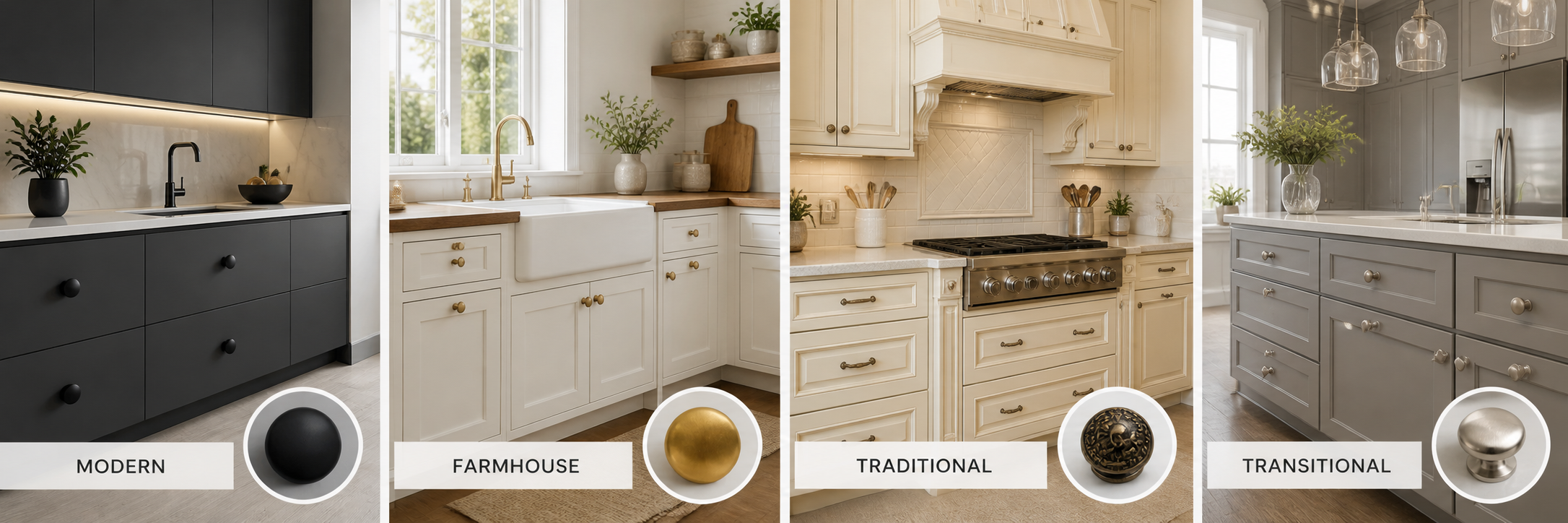
Every kitchen has a design language, a set of visual cues that tell you what kind of space it is before you consciously register any individual element. The tile, the cabinetry, the countertops, the light fixtures, each one contributes a line or two. The hardware is the punctuation. It does not write the sentence, but it tells you how to read it.
Cabinet knobs are the most visible single-point hardware element in a kitchen. They sit at eye level on upper cabinet doors, at hand level on lower doors, and at the exact point where the eye naturally lands when someone enters the room and reaches for the first thing they need. A knob that matches the kitchen's design language reinforces every other decision that went into the space. A knob that does not match introduces a note of visual confusion that is difficult to identify but impossible to ignore.
This guide covers ten of the most common kitchen design styles, what defines each one visually, which Jeffrey Alexander cabinet knob collections and finishes work best within it, and which tile types from the Tile Choices catalog pair naturally with both the cabinetry and the hardware. Every recommendation is drawn from the cabinet knobs collection and the broader Jeffrey Alexander cabinet hardware line, with coordinating tile suggestions linked directly to the relevant collections.
1. Shaker Kitchen
Shaker is the most installed kitchen style in residential renovation and has been for decades. Its defining characteristics are flat-panel center inserts framed by a simple rail-and-stile perimeter, clean, unfussy, honest about its construction. The style originated in the Shaker religious community and carries their values into its aesthetics: nothing applied for appearance alone, nothing that does not serve the form.
Shaker cabinetry is the most hardware-versatile door style that exists. Its flat center panel and simple frame do not impose any particular hardware direction, it accepts traditional knobs, contemporary bar pulls, and everything in between without creating a style conflict. For a Shaker kitchen that leans traditional, a round or slightly domed knob in Satin Nickel or Brushed Oil Rubbed Bronze from a collection like Belcastel 1 or Annadale suits the door's quiet dignity. For a Shaker kitchen that leans contemporary, a clean round or square-profiled knob in Matte Black or Brushed Gold from the Sutton or Alvar collection reads as modern without undermining the Shaker door's simplicity.
Tile pairing: Shaker kitchens look most resolved with classic subway tile on the backsplash, 3x6 or 4x12 ceramic or glass in white or off-white. Explore the kitchen backsplash tile collection for subway options that coordinate with the warm and cool finish directions in the Jeffrey Alexander Shaker-suitable collections.
2. Modern Farmhouse Kitchen
Modern farmhouse is the style that brought shiplap, apron-front sinks, and open shelving into mainstream renovation and kept them there. It is defined by the tension between utilitarian materials, raw wood, painted beadboard, aged metal, and the comfort of a well-lived-in home. Cabinetry tends to run painted white or cream with inset or face-frame construction, and the hardware is expected to feel earned rather than decorative.
Modern farmhouse kitchens are where cup pulls and bin pulls are most at home on drawers, but for doors, a knob with a slightly weathered or forged quality suits the aesthetic. Look at the Key West collection in Brushed Oil Rubbed Bronze or Distressed Antique Brass, or the Bordeaux collection for a knob with enough character to suit the farmhouse commitment to materials that show their history. Lightly Distressed Antique Brass is a particularly good finish direction for farmhouse kitchens, it reads as old without looking worn out.
Tile pairing: Modern farmhouse backsplashes often use handmade-look ceramic, brick-format tile, or classic white subway with dark grout. The backsplash tile collection includes options in textured ceramic and varied-finish formats that suit the farmhouse preference for materials with presence and character over clinical perfection.
3. Contemporary Kitchen
Contemporary kitchens are defined by what they leave out. Flat-panel or slab cabinet doors with no applied detail, minimal ornamentation, clean lines from countertop to ceiling, and hardware that contributes geometry rather than decoration. In a true contemporary kitchen, the hardware should look as if it grew out of the door rather than being placed on it.
For contemporary kitchens, the knob choice is intentionally restrained. A perfectly round sphere knob or a slightly domed round profile in Matte Black, Brushed Gold, or Gun Metal reads as a deliberate geometric element in a room built on geometry. The Alvar and Boswell collections offer the kind of clean, minimal knob profile that suits a flat-panel door without adding visual noise. Many contemporary kitchen designers skip knobs on doors entirely in favor of bar pulls throughout, a valid and increasingly standard approach for this style. If knobs are used, they should be from the same collection as the pulls for absolute visual consistency.
Tile pairing: Contemporary kitchens suit large-format tile, minimal-grout-line porcelain, and glass tile on the backsplash. Full-height backsplashes in a single tile material with very tight or color-matched grout are a hallmark of contemporary kitchen design. Browse the kitchen backsplash collection for large-format and glass options that suit the contemporary commitment to seamless surfaces.
4. Transitional Kitchen
Transitional is the style that refuses to commit entirely to either traditional or contemporary, and it is the most popular design direction in residential kitchens today for exactly that reason. It is the style that suits the most houses, coordinates most easily with existing architecture, and ages most gracefully. Transitional kitchens use clean lines without the severity of pure contemporary, and traditional references without the formality of classic design.
Transitional hardware walks the same line. The Hayworth and Belcastel 1 collections from Jeffrey Alexander are the strongest transitional knob choices, they have enough detail to reference traditional design without the ornate quality that would push the kitchen toward a more formal aesthetic. Satin Nickel is the default finish for transitional kitchens because it sits perfectly between the warmth of bronze finishes and the cool brightness of chrome. Brushed Gold and Polished Nickel are the two finishes most likely to push a transitional kitchen in a warmer or more elevated direction.
Tile pairing: Transitional backsplashes work beautifully with beveled subway tile, classic herringbone layouts, and neutral stone-look porcelain. The backsplash collection covers all three of these directions with options that suit the transitional palette of warm neutrals, greige, and soft white.
5. Coastal Kitchen
Coastal kitchens draw from the light, air, and materiality of seaside environments, bleached wood tones, soft blues, creamy whites, natural textures, and the relaxed quality of a room that does not take itself too seriously. Cabinetry runs in white, linen, driftwood gray, or soft sage, and the hardware should feel light rather than heavy, nothing that reads as formal or metropolitan.
For coastal kitchens, Brushed Nickel and Polished Nickel are the natural hardware finish directions, they echo the light quality of a room oriented toward natural light and pale surfaces. Polished Chrome adds a slightly crisper note that suits coastal kitchens with a more contemporary lean. For a softer coastal look, Brushed Gold in a light, non-saturated version adds warmth without heaviness. The Sutton collection offers a clean, simple knob that suits coastal cabinetry without introducing any style notes that conflict with the light, relaxed aesthetic. Paired with coordinating cabinet pulls on drawers, this combination covers the full kitchen consistently.
Tile pairing: Coastal kitchen backsplashes often feature glass tile, sea-glass-toned ceramic, white subway with soft gray grout, or light stone-look porcelain. The backsplash tile collection includes glass and ceramic options in the light blues, greens, and neutral whites that define coastal tile palettes.
6. Industrial Kitchen
Industrial kitchens are built on the aesthetic of raw, honest materials, exposed brick, concrete, dark metal, reclaimed wood, and hardware that looks like it could survive a factory floor. The style is urban, unsentimental, and defined by the texture and weight of its materials. Cabinetry tends to run dark, charcoal, near-black, dark navy, or the warm darkness of aged wood, and the hardware should have the same material honesty as everything else in the room.
For industrial kitchens, Gun Metal and Matte Black are the finish directions that suit the style's commitment to dark, non-precious materials. A round knob in Gun Metal has the quality of a machined part, functional, material, without decoration. The Boswell collection and the Milan series from Jeffrey Alexander offer profiles that suit industrial cabinetry without softening the aesthetic with curves or ornament. On drawers, bar pulls in a matching finish reinforce the industrial commitment to clean, utilitarian geometry. Avoid patinated or antiqued finishes in industrial kitchens, they read as decorative rather than structural, which conflicts with the style's values.
Tile pairing: Industrial kitchen backsplashes use concrete-look porcelain, dark ceramic, brick-format tile in charcoal or dark red, and occasionally metal tile for a fully committed industrial statement. The backsplash collection includes dark and concrete-look options that suit the industrial palette.
7. Traditional Kitchen
Traditional kitchens are the most architecturally detailed, raised-panel cabinet doors, furniture-style toe kicks, crown molding at the ceiling, and hardware that participates in the room's architectural conversation rather than stepping aside from it. These are kitchens built to look as if they have been there for generations, with the formal quality of a room in a house that has history.
Traditional kitchens call for knobs with architectural presence. The Bordeaux, Audrey, and Annadale collections from Jeffrey Alexander offer carved and shaped profiles that echo the raised-panel door's own relief detail. Finish direction in traditional kitchens runs warm, Brushed Oil Rubbed Bronze, Satin Bronze, Lightly Distressed Antique Brass, and Polished Brass are the classic choices. Distressed finishes that suggest age and use are more at home in traditional kitchens than in any other style because the room is built around the idea of accumulated time. Pair knobs on doors with coordinating cabinet pulls on drawers, the mixed approach is not only traditional convention but the most practical hardware solution for a kitchen with substantial drawer storage.
Tile pairing: Traditional kitchen backsplashes often feature handmade-look ceramic in warm creams and ivories, natural stone tile with visible variation, or decorative mosaic inserts behind the range. Browse the backsplash tile collection for handmade and stone-look options that suit the warm, layered palette of a traditional kitchen.
8. Rustic Kitchen
Rustic kitchens embrace the imperfect, the natural, and the hand-made. Natural wood cabinetry in warm honey and walnut tones, stone countertops, forged metal hardware, and tile that looks like it was pulled from a centuries-old European building. These are kitchens that celebrate texture over polish, warmth over precision, and character over consistency.
Hardware for rustic kitchens leans heavily toward the heavier, more tactile end of the Jeffrey Alexander range. Knobs with a forged or hand-finished quality, slightly irregular profile, distressed or antiqued finish, material weight that reads as crafted rather than manufactured, are most at home in a rustic kitchen. Distressed Antique Brass, Distressed Oil Rubbed Bronze, and Brushed Pewter are the finish directions that carry the right material quality. Collections with more organic profile, less machined precision, more handmade character, suit the rustic aesthetic better than collections built on clean geometric lines.
Tile pairing: Rustic kitchen backsplashes use natural stone, terracotta, handmade ceramic with visible variation, and Saltillo-style tile that brings earthen warmth. The backsplash tile collection includes stone and textured ceramic options that pair naturally with distressed hardware finishes and warm wood cabinetry.
9. Mid-Century Modern Kitchen
Mid-century modern draws from the post-war period of American design, 1945 to 1970, when furniture and architecture explored the possibilities of new materials and manufacturing processes. The style is defined by organic curves, warm wood tones, bold color accents, and a combination of the handcrafted and the industrial that reads as both human and precise. In kitchens, MCM shows up in flat-panel cabinetry in warm wood veneers or two-tone painted schemes, and hardware that references the period's own design vocabulary.
For mid-century modern kitchens, the most authentic hardware directions are round knobs with a slightly domed or sculpted profile in Brushed Gold, Satin Bronze, or Polished Brass, finishes that echo the warm metal tones of the era's furniture hardware. The Alvar collection in Brushed Gold suits MCM cabinetry cleanly, providing enough warmth to reference the period without looking like a costume. On drawers, a coordinating bar pull or handle pull in the same finish reinforces the period's commitment to clean, functional hardware that earns its place through form.
Tile pairing: Mid-century modern backsplashes are at their best with ceramic tile in warm white, soft butter yellow, or avocado green, colors that reference the era's design palette, or with simple rectangular or square ceramic in a matte finish that suits the style's clean surfaces. The backsplash tile collection includes ceramic options in warm, matte finishes that suit MCM kitchens.
10. Maximalist Kitchen
Maximalist kitchens are the counterpoint to contemporary minimalism, layered, bold, pattern-rich, and unafraid of color, texture, and visual complexity. These are kitchens where the tile is the star, the hardware is part of a larger decorative scheme, and the goal is not restraint but richness. Cabinetry in maximalist kitchens often appears in unexpected colors, deep emerald green, cobalt blue, warm terracotta, dusty mauve, and the hardware is expected to participate in that boldness rather than disappear from it.
For maximalist kitchens, knob profile and finish can be bolder than in any other style. Ornate collections with carved detail, shaped profiles, and decorative presence, Bordeaux, Audrey, or more elaborate collections in the Jeffrey Alexander range, suit the maximalist commitment to richness over restraint. Finish direction depends on the cabinet color: Brushed Gold against deep green or navy blue cabinetry is one of the strongest current design combinations in the maximalist category. Polished Nickel or Polished Chrome suits cobalt or cooler cabinet colors. Satin Bronze pairs beautifully with terracotta or warm rust cabinetry. The finish and tile pairing guide covers how to coordinate hardware finish with bold tile choices in detail.
Tile pairing: Maximalist backsplashes are where patterned tile, encaustic designs, bold mosaics, and large-format decorative ceramic live. The kitchen backsplash tile collection includes mosaic, patterned, and decorative options that suit kitchens built around visual complexity and layered design.