Walk into any kitchen showroom and you will find four distinct types of cabinet hardware on display, knobs, pulls, bar pulls, and handle pulls. They look different, they install differently, and they suit different applications. But the guidance you get is often vague: "knobs on doors, pulls on drawers" is the standard rule, repeated so often it has become a reflex rather than a reasoned decision.
The reality is more nuanced and more interesting. There are good reasons why certain hardware types work better in certain applications, and understanding those reasons gives you a framework for making decisions that go beyond the rule of thumb. This guide covers each hardware type in detail, how it works, where it is strongest, and where it falls short, so you can dress every cabinet in your kitchen, bathroom, or furniture piece with hardware that makes sense for the specific application.
All hardware types discussed here are available in the Jeffrey Alexander cabinet hardware collection at Tile Choices, with dozens of collections spanning every finish and style direction.
The Four Main Types of Cabinet Hardware
Cabinet Knobs
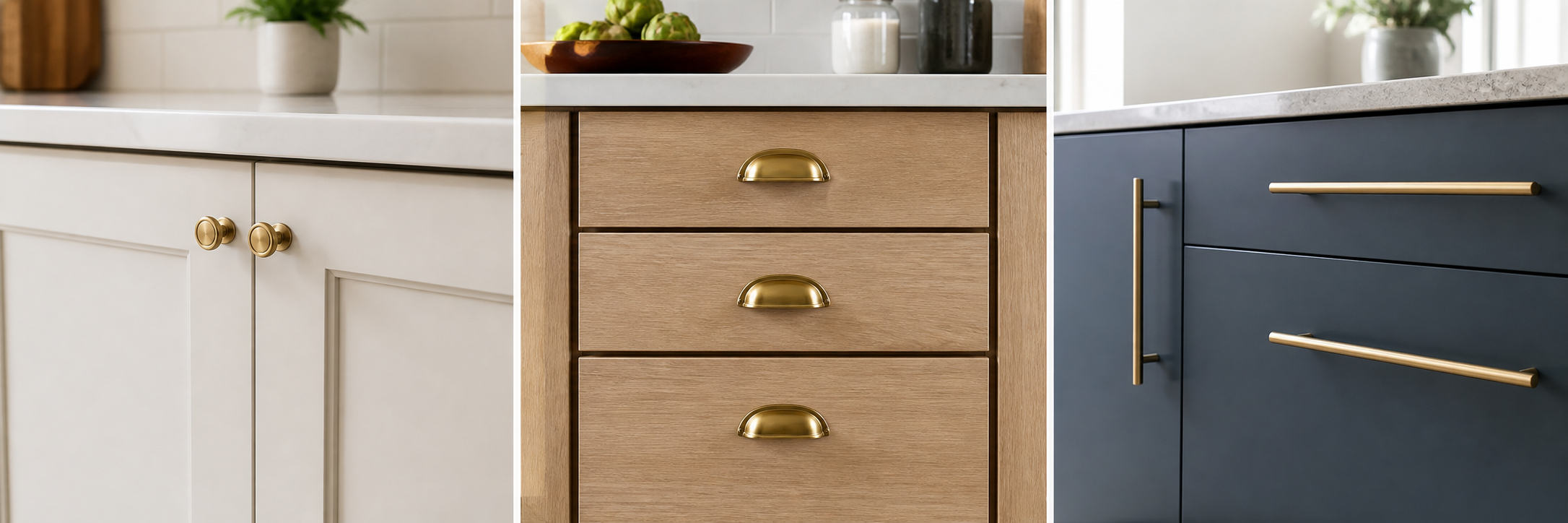
A cabinet knob is a single-point hardware piece that mounts with one screw through a single hole in the cabinet door or drawer front. The knob projects from the surface and provides a grip point for opening the door or drawer. Knob sizes in the Jeffrey Alexander line range from roughly 1 inch to 1 1/2 inch diameter, with some larger statement knobs running up to 2 inches.
Knobs are the traditional choice and have the longest history in cabinet hardware design. Their single-hole installation makes them easy to retrofit onto existing cabinetry without drilling new holes, and their compact footprint suits cabinet doors where a larger hardware piece would look oversized. The trade-off is grip, a knob provides less surface area to hold than a pull, which makes it less ergonomically suited to heavy drawers or wide cabinet doors that require more leverage to open.
Browse the full range of cabinet knobs at Tile Choices to see how different shapes, sizes, and finishes work across kitchen and bathroom applications.
Cabinet Pulls
A cabinet pull uses two screws set at a fixed center-to-center distance, the measurement between the two holes. This two-point mounting creates a horizontal or vertical bar that the hand grips to open the door or drawer. Pulls provide more grip surface than knobs, making them better suited to heavier drawers and larger cabinet doors. They also read as a more contemporary choice than knobs in most design contexts.
Cabinet pulls in the Jeffrey Alexander line span center-to-center measurements from 3 inches (76mm) up to 8 13/16 inches (224mm) and in some collections to 12 and 18 inches for wide drawer banks and appliance panels. The variety of sizes within a single collection is what allows you to scale hardware proportionally across different drawer widths without changing the hardware family or finish. See the full cabinet pulls collection for the complete range of profiles and sizes.
Bar Pulls
Bar pulls are a subset of the cabinet pull category defined by their profile: a straight, cylindrical, or tubular bar that runs parallel to the cabinet surface, mounted at each end with a screw. The defining characteristic is the clean, unadorned geometry, no curves, no feet, no decorative detail. Just a bar.
This simplicity is exactly why bar pulls have become the dominant hardware choice in modern and contemporary kitchens. Flat-panel and slab cabinet doors have the same geometric clarity as a bar pull, and the hardware echoes rather than interrupts the door's own lines. Bar pulls also scale extremely well, the same profile that works on a 96mm drawer pull works on an 18-inch appliance handle, creating a seamless visual continuity across the entire kitchen. Browse bar pulls at Tile Choices to see the range of profiles, diameters, and finishes available through Jeffrey Alexander.
Appliance Pulls
Appliance pulls share the two-hole mounting of cabinet pulls but have a wider, more substantial profile, often a broader grip, a more architectural shape, or a design with more visual presence than a standard pull. The distinction between a pull and a handle pull is not always precise, but handle pulls generally have more hand clearance, a wider grip surface, and more visual weight that suits larger-scale applications, wide drawer fronts on furniture-style cabinetry, pantry doors, or any application where a thinner pull profile would look underdressed relative to the scale of the cabinet. See the handle pulls collection for options across the Jeffrey Alexander range.
Where Each Hardware Type Works Best
Cabinet Doors: The Case for Knobs
The traditional rule, knobs on doors, pulls on drawers, exists for good practical reasons. A cabinet door swings on a hinge and requires only enough grip to pull it away from the frame. A single knob provides that grip with minimal hardware footprint on the door face, and its round or compact shape does not interfere visually with the door's panel detail the way a horizontal pull can. On raised-panel doors especially, a round knob positioned in the upper third of the door sits naturally within the panel geometry rather than cutting across it.
On Shaker doors, knobs and short pulls both work well, the flat-panel center of a Shaker door is neutral enough to accept either without conflict. The decision often comes down to finish and the overall feel you want: a round knob reads slightly more traditional; a short cup pull or a small bar pull reads more contemporary.
Drawers: Why Pulls Are the Stronger Choice
Drawers require more pull force than doors, particularly in kitchens where drawers are deep and carry significant weight, pots, pans, utensil collections. A pull's two-point grip distributes the opening force more evenly across the drawer front, reducing the racking stress that knobs can place on a single-point mount over time. For drawers wider than 12 inches, a proportionally sized pull also reads better visually, a small knob centered on a wide drawer front looks undersized in a way that a correctly scaled pull does not.
For wide drawer fronts, 18 inches or more, a longer pull or a bar pull that spans a more significant portion of the drawer width creates the most resolved look. The Jeffrey Alexander collections that offer multiple center-to-center options (96mm, 128mm, 160mm, 192mm) within the same design family are designed specifically for this purpose: the same hardware family scales across a full kitchen's range of drawer sizes without requiring a different collection for different drawers.
Using the Same Pull Type Throughout
An increasingly popular approach in contemporary kitchen design is to abandon the knobs-on-doors, pulls-on-drawers convention entirely and use a single pull type, typically a bar pull or a standard cabinet pull, on every surface. This approach creates a cleaner, more unified look that suits modern and minimalist kitchens especially well. When all the hardware is the same profile and finish, the kitchen reads as a single designed surface rather than a collection of individual elements. The trade-off is that it requires a collection with enough size options to scale properly across every cabinet, which the better Jeffrey Alexander collections are specifically built to provide.
Cup Pulls: The Drawer Specialist
Cup pulls, also available through the Jeffrey Alexander collection, are a single-hole pull that mounts like a knob but provides a deeper, curved bowl-shaped grip suited specifically to drawers. They are a traditional choice for kitchen drawers in farmhouse, cottage, and transitional kitchens where a bar pull would feel too modern. The cup pull's bowl shape provides excellent grip for heavy kitchen drawers while maintaining a softer, more decorative profile than a straight pull.
Appliance Pulls: Scale and Proportion for Large Panels
Refrigerator panels, dishwasher fronts, and range drawers operate at a different scale than standard cabinetry. An appliance pull needs to span enough of the panel's width to look proportional, typically 12 to 18 inches, and needs the structural integrity to handle the repeated force of opening a heavy appliance door. Jeffrey Alexander's appliance pull options within its major collections are designed to match the same profile as the standard cabinet pulls in that collection, which is what allows refrigerator panels to match the kitchen hardware rather than requiring a separate hardware purchase that never quite coordinates. These are available through the Jeffrey Alexander collection page at Tile Choices.
Sizing Rules That Actually Work
Proportion is the practical foundation of hardware selection. A few sizing rules that hold across most applications:
For cabinet doors, position hardware one to two inches from the corner on the opening side of the door. For upper cabinet doors, hardware goes near the bottom of the door; for lower cabinet doors, near the top. This is consistent across both knobs and pulls and ensures the hardware is ergonomically placed where the hand naturally reaches.
For drawers, the one-third rule is the most reliable guide: choose a pull whose center-to-center measurement spans approximately one-third of the drawer front width. A 12-inch drawer front suits a 96mm (3 3/4 inch) pull. An 18-inch drawer suits a 128mm to 160mm pull. A 24-inch or wider drawer front can carry a 192mm to 224mm pull or an 18-inch bar pull, depending on the collection and how bold you want the hardware to read.
When in doubt, go slightly larger rather than smaller. Hardware that is proportionally slightly large reads as intentional and confident. Hardware that is proportionally slightly small reads as an afterthought.
Matching Hardware Type to Cabinet Door Style
Cabinet door style is the clearest guide to hardware type compatibility. Flat-panel and slab doors read best with bar pulls and minimal handle pulls, the clean geometry of the door and the hardware echo each other. Shaker doors work with almost everything, knobs, pulls, bar pulls, and cup pulls all suit the Shaker door's balanced combination of frame detail and flat center panel. Raised-panel doors are most resolved with knobs and shorter pulls that complement the door's own relief detail rather than cutting across it. Beadboard and inset doors tend to look best with cup pulls or traditional knobs that reference the historical context of those door styles.
For a deeper look at how hardware finish interacts with tile and the rest of the kitchen palette, read our companion guide: How to Choose the Right Cabinet Hardware Finish for Your Kitchen Tile.