Cabinet pull sizing is the question that stops more hardware purchases in their tracks than any other. The finish decision is a matter of taste. The profile decision follows from cabinet door style. But the sizing decision feels technical, and the stakes feel higher because getting it wrong means either returning hardware, drilling new holes, or living with pulls that do not line up. None of those outcomes is particularly appealing, which is why so many people spend longer than necessary on this part of the decision.
The good news is that center-to-center measurement is not complicated once you understand what the number means and how to use it. This guide covers everything you need to know: how to measure existing holes for replacement pulls, how to choose the right size for new installations, how to handle situations where standard sizes do not quite work, and how to scale pull sizes proportionally across a full kitchen's worth of different drawer widths. By the time you finish reading, sizing will be the easy part of the hardware decision.
All pull sizes and collections referenced in this guide are available through the Jeffrey Alexander cabinet pulls collection at Tile Choices, with coordinating bar pulls and cabinet knobs in matching collections and finishes.
What Center-to-Center Actually Means
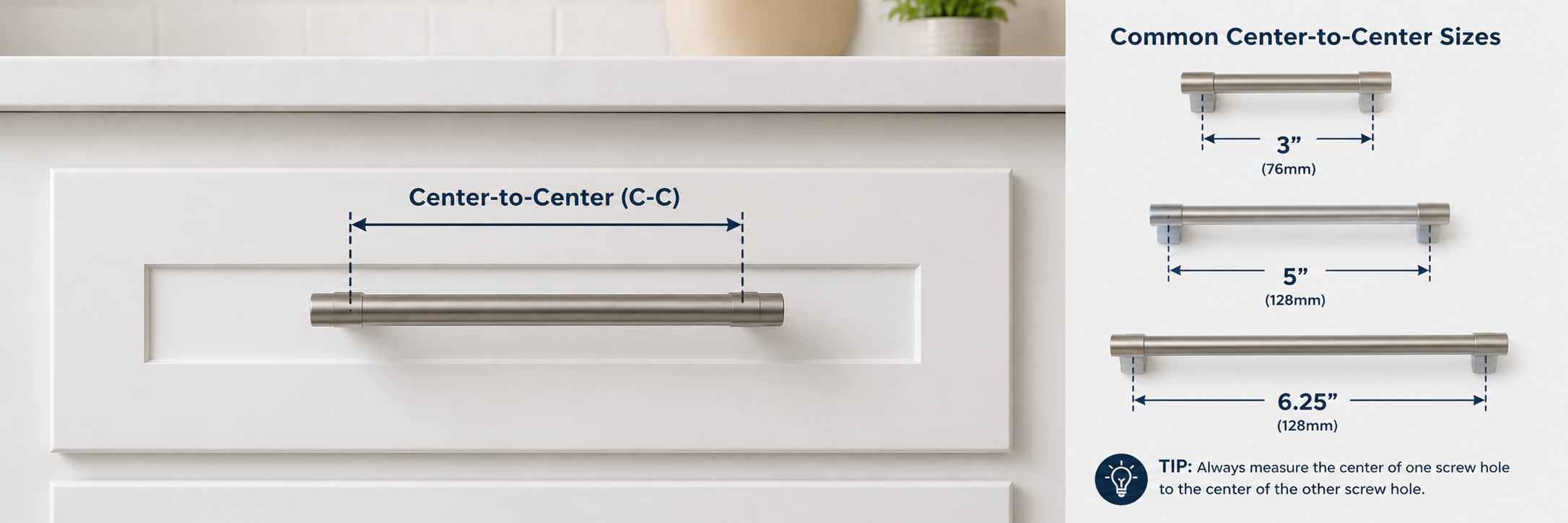
Center-to-center, abbreviated cc or CTC on product listings, is the distance between the center point of one mounting screw hole and the center point of the other. It is not the overall length of the pull, which is always longer than the center-to-center measurement because the pull extends past each mounting hole on both ends. It is not the grip length, the actual span of bar the hand holds, which is usually slightly shorter than the center-to-center. Center-to-center is purely the hole-to-hole distance, and it is the only measurement that determines whether a pull fits your existing cabinet holes or requires new drilling.
This distinction matters because product listings and physical pulls display three different length measurements: overall length, center-to-center, and sometimes grip length. All three numbers appear on Jeffrey Alexander product pages. The one you need for fitting purposes is always center-to-center. When a pull is listed as a "96mm pull" or a "3 3/4 inch pull," that number refers to center-to-center, not overall length. A 96mm center-to-center pull may have an overall length of 4 1/2 inches or more depending on the collection's end cap design.
Standard Center-to-Center Sizes in the Jeffrey Alexander Line
The Jeffrey Alexander cabinet pulls collection uses standard center-to-center measurements that align with the industry-wide sizing system used across virtually all cabinet hardware brands. Standard sizes run as follows:
76mm (3 inch), the smallest standard pull size, suited to narrow drawers and small door applications. 96mm (3 3/4 inch), the most widely used pull size in residential kitchens, appropriate for drawers in the 10 to 15 inch width range. 128mm (5 inch), the next step up, suited to 15 to 18 inch drawer fronts and wider door applications. 160mm (6 1/4 inch), appropriate for 18 to 22 inch drawer fronts and horizontal door pull applications. 192mm (7 1/2 inch), suited to wider drawer banks, island drawers, and larger door applications. 224mm (8 13/16 inch), the upper end of the standard range, appropriate for wide island drawers and oversized door fronts. Appliance pull formats within select collections extend to 12 inch and 18 inch center-to-center for refrigerator panels, range drawer fronts, and dishwasher panels.
Not every collection offers every size, the most complete collections in the Jeffrey Alexander line typically span from 96mm through 192mm or 224mm, with some offering 76mm as a smallest option. Before committing to a collection, verify that it offers all the center-to-center sizes needed across your full range of drawer widths.
Measuring for Replacement Pulls: Step by Step
Step One: Measure the Existing Holes
With the existing pull still in place or removed, position a tape measure or rigid ruler against the cabinet door face. Measure from the center of one screw hole to the center of the other. The center of a screw hole is its exact midpoint, for a standard 5/32 inch drill hole, the center is at the midpoint of the hole's diameter. If the existing pull is still installed, you can measure from screw center to screw center by measuring between the screws at the back of the door, or by measuring between the visible mounting holes on the door face.
Write this measurement down in both millimeters and inches and cross-reference it against the standard size chart above. Most existing residential cabinet pulls will match one of the standard sizes precisely. If your measurement falls exactly on a standard size, your replacement pull search is straightforward, filter by that center-to-center size in the cabinet pulls collection and every pull that appears will fit your existing holes.
Step Two: Verify Across Multiple Drawers
Before ordering, verify the center-to-center measurement on at least three different drawers, one from the upper run, one from the lower run, and one from any island or secondary bank if applicable. In a professionally installed kitchen, all drawers in the same run should have identical hole spacing. In kitchens where hardware was installed at different times or by different contractors, minor variations occasionally exist. Catching an inconsistency before ordering prevents the situation where most pulls fit but a handful of drawers require different hardware.
Step Three: Account for Door Hardware
If your cabinet doors currently have pulls rather than knobs, measure those separately. Door pulls are often a different center-to-center size than drawer pulls, a common configuration uses 96mm pulls on drawers and 128mm pulls mounted vertically on doors, where the longer vertical span suits the taller door front better than the shorter drawer pull. If you are replacing like for like, measure doors and drawers independently and confirm the new collection offers both sizes in the same design and finish.
Choosing Pull Size for New Installations: The One-Third Rule
For new cabinetry where no existing holes constrain the choice, pull sizing follows a proportion principle rather than a fixed measurement. The most reliable rule is the one-third guideline: choose a pull whose center-to-center measurement spans approximately one-third of the drawer front width. This proportion reads as naturally balanced, the pull does not look undersized against the drawer, and it does not crowd the edges.
Applied to common drawer widths: a 12 inch drawer front pairs well with a 96mm (3 3/4 inch) pull. A 15 inch drawer front suits a 96mm or 128mm pull depending on how prominent you want the hardware to read. An 18 inch drawer front is most proportional with a 128mm or 160mm pull. A 24 inch drawer front, common on island drawer banks, reads best with a 160mm or 192mm pull. A 30 inch wide drawer front can carry a 192mm or 224mm pull, or in contemporary kitchens where the hardware makes a deliberate statement, an 18 inch bar pull that spans a more significant portion of the drawer width.
When in doubt between two adjacent sizes, go larger. Hardware professionals consistently observe that clients who select pull size without a physical reference tend to choose smaller than what reads correctly once installed. A pull that looks slightly large in isolation almost always looks exactly right once it is on the door with the full cabinet context around it.
Scaling Pull Size Across a Full Kitchen
Maintaining a Single Collection Across Multiple Sizes
The most important pull sizing principle for a full kitchen is this: use a single Jeffrey Alexander collection that offers all the center-to-center sizes you need across every drawer and door in the space. A collection that only offers 96mm and 128mm will not work for a kitchen that also has 30 inch island drawers requiring a 192mm or 224mm pull. Check the full size range of any collection before committing.
Collections in the Jeffrey Alexander line that offer the broadest size range, typically Alvar, Sutton, and Hayworth, span from 96mm through 224mm or to appliance pull lengths, which is why these collections appear consistently in full-kitchen hardware specifications. They solve the scaling problem by design rather than requiring a workaround.
A Practical Kitchen Sizing Example
A typical kitchen might include upper cabinet doors at 12 inches wide, lower cabinet doors at 15 inches wide, standard base cabinet drawers at 12 to 15 inches, a wide pot-and-pan drawer at 24 inches, and a refrigerator panel. Using a single Jeffrey Alexander collection in Brushed Gold with this hardware plan: 96mm pulls on standard drawers, 160mm pulls on the wide pot-and-pan drawer, a 96mm pull mounted vertically on upper doors, a 128mm pull mounted vertically on lower doors, and an 18 inch appliance pull on the refrigerator panel. Every piece is in the same collection, the same finish, and scaled to the specific application, the hardware reads as a designed system rather than a series of individual decisions.
For guidance on which finish to choose for your specific tile palette, the hardware finish and tile pairing guide covers every major tile type from warm subway to natural stone to dark porcelain. For the full room coordination approach from tile selection through hardware, the cohesive kitchen design guide covers the complete decision sequence.
When Existing Holes Do Not Match Standard Sizes
Holes That Fall Between Standard Sizes
Occasionally, existing cabinet pulls were installed with a non-standard center-to-center measurement, particularly in older kitchens, imported cabinetry, or renovations where hardware was sourced internationally. If your existing hole spacing falls between two standard sizes, say, 110mm when the nearest standards are 96mm and 128mm, you have several options.
The cleanest solution for most situations is to fill the existing holes and redrill at the correct position for the standard size closest to your preference. Filling is done with a small amount of wood filler or wood putty, sanded flush with the door face and touched up with paint or stain. The filled holes are invisible once the new pull is installed. This approach gives you access to the full Jeffrey Alexander range without any fitting compromise.
Using Backplates to Cover Old Holes
Where filling and redrilling is not practical, in kitchens with painted finishes that would show patching, or where the door material does not accept filler cleanly, a backplate is the most elegant solution. A backplate is a decorative plate that mounts between the pull and the door surface, covering the existing holes while the new pull mounts through it in the correct position for the standard center-to-center. Jeffrey Alexander offers coordinating backplates in matching finishes for most of its major collections, making this a visually seamless solution when the old and new hole positions are close enough that a standard-size backplate covers both. Contact the Tile Choices team at sales@tilechoices.com for backplate availability in specific collections and finishes.
Pull Sizing for Bathroom Vanities
Bathroom vanity drawer pulls follow the same one-third proportional rule as kitchen drawers, applied to narrower drawer fronts. Standard single-sink vanity drawers run 12 to 18 inches wide, which suits 96mm pulls as the default choice. Double-sink vanity configurations with wider drawer banks, 24 to 30 inches, suit 128mm or 160mm pulls proportionally. For vanity door hardware, a coordinating cabinet knob on the door with a pull on the drawer is the classic approach, or use the same pull on both for a contemporary unified look.
Finish coordination for bathroom vanity hardware follows the same tile palette logic as the kitchen, see the cohesive design guide for bathroom-specific finish and tile pairing guidance, or browse the bathroom tile collection alongside the hardware options for a complete palette view before committing to either.