Cabinet knob size is the hardware decision that most people get wrong, not because it is complicated, but because they make it without a reference point. A knob that looks right on a product page or in a showroom display can look undersized or oddly large once it is installed on an actual cabinet door. The door is bigger than you remembered. The profile of the knob is smaller than the photo suggested. Or everything fits dimensionally but something still feels off and you cannot quite place why.
The answer is almost always proportion. Cabinet knob sizing is not really about picking a diameter, it is about choosing a knob whose visual weight matches the scale of the door it sits on, the drawer it opens, and the room it lives in. Get that relationship right and the hardware disappears into the design in the best possible way. Get it wrong and the hardware is all anyone notices.
This guide covers how to size cabinet knobs correctly for every room and application in the home, kitchen cabinets, bathroom vanities, furniture drawers, laundry rooms, and pantry cabinetry, using practical rules that work across the full Jeffrey Alexander cabinet knobs range. By the time you finish reading, you will know exactly what size to order.
Why Knob Size Matters More Than Most People Expect
Hardware is one of the few elements in a room that operates at two scales simultaneously. From across the room, a knob reads as a dot of color or a flash of finish, its contribution to the overall palette and visual rhythm of the cabinetry. Up close, it is a tactile object with specific weight, diameter, and projection that determines how the door or drawer feels to open. A knob that fails at either scale fails the room.
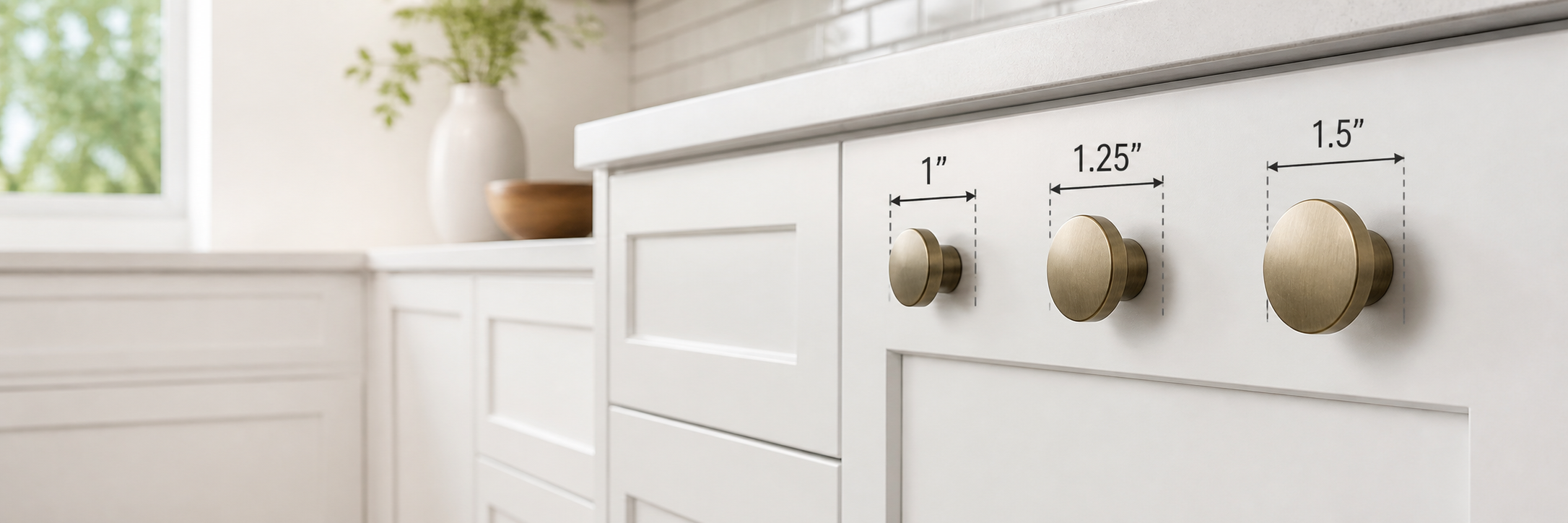
The most common sizing mistake is going too small. Designers consistently observe that clients who select knob size without a physical reference almost always choose a size that looks undersized once installed. A 1-inch knob on a 15-inch wide cabinet door looks like a button. A 1 1/4-inch knob on the same door looks considered. A 1 1/2-inch knob looks intentional and confident. The difference in actual diameter is a matter of millimeters, but the visual difference on an installed door is significant.
The second most common mistake is inconsistency, using different knob sizes across different rooms or different cabinet types in the same space without a logical reason. A home where every room has hardware selected independently, without reference to a shared sizing logic, produces a collected-not-designed feeling that good hardware choices are supposed to prevent. The Jeffrey Alexander cabinet hardware line is built as a system specifically to prevent this, collections offer consistent proportions across knob sizes so the hardware reads as unified whether it is on a kitchen cabinet or a bathroom vanity.
The Core Sizing Vocabulary
Before getting into room-by-room guidance, a quick vocabulary note. Cabinet knob size is described in two ways: overall diameter (the widest measurement of the knob face) and projection (how far the knob extends from the cabinet surface). Both matter. Diameter determines visual scale. Projection determines how the knob feels in the hand and how much clearance there is when the door is closed flush against an adjacent surface.
Most Jeffrey Alexander knobs run in a projection range of 1 inch to 1 1/2 inches. Standard diameters across the collection run from approximately 1 inch to 1 1/2 inch for round and shaped knobs, with some collections offering slightly larger statement sizes. When a product listing gives a single measurement, say, 1 1/4 inch, it typically refers to the diameter unless otherwise specified. Always verify both measurements on the product page before ordering if projection clearance matters for your specific installation.
Kitchen Cabinet Knobs: Sizing by Door and Drawer Type
Standard Upper and Lower Cabinet Doors
The kitchen is where cabinet knob sizing is most visible and most consequential. Standard upper cabinet doors run 12 to 15 inches wide in most kitchen configurations. For doors in this range, a knob with a 1 1/4-inch diameter is the reliable default, large enough to read clearly on the door face, small enough to remain proportional to the door width. A 1-inch knob on a standard upper cabinet door works but tends to look like a minimum rather than a choice. If you want the hardware to have visual presence, 1 1/4 inch is the better call.
Standard lower cabinet doors run wider, typically 15 to 18 inches in a standard kitchen layout, wider in furniture-scale or custom configurations. For lower cabinet doors in the 15-to-18-inch range, a 1 1/4-inch to 1 1/2-inch knob is proportionally appropriate. For lower cabinet doors wider than 18 inches, common on base cabinets with larger openings, a 1 1/2-inch knob is the right scale, or you may want to consider switching to a short cabinet pull for doors that wide, where a pull provides both better proportion and better ergonomics.
Pantry and Tall Cabinet Doors
Pantry doors and tall cabinet doors present a scale challenge. A full-height pantry door, 84 inches or taller, 18 to 24 inches wide, is essentially a furniture piece, and a standard 1 1/4-inch knob can look lost against that much door surface. For pantry and tall cabinet applications, a 1 1/2-inch knob is the minimum, and many designers opt for a handle pull on pantry doors precisely because the two-point mounting and longer profile read more proportionally against a large door. If you are committed to knobs throughout the kitchen for style consistency, a 1 1/2-inch knob positioned correctly, about 60 inches from the floor on a full-height pantry door, reads as intentional.
Kitchen Drawer Fronts
Knobs on kitchen drawers are a traditional choice that works well in certain design contexts, farmhouse, cottage, unfitted kitchens, and spaces where the design skews decidedly traditional. When using knobs on drawers rather than bar pulls or cabinet pulls, size the knob to the drawer width using the same proportional logic as doors. A single 1 1/4-inch knob centered on a 12-inch drawer front reads correctly. On a wider 18-to-24-inch drawer front, one centered knob looks undersized, either use a 1 1/2-inch knob or, more practically, switch to a pull for wide drawers and reserve knobs for the doors.
Bathroom Vanity Knobs: Where Proportion Is Even More Visible
Bathroom vanity cabinetry operates at a smaller scale than kitchen cabinetry in most homes, which makes knob proportion even more visible. A vanity door that is 12 inches wide, common in single-sink vanity configurations, suits a 1-inch to 1 1/4-inch knob. The smaller door width means a 1 1/2-inch knob can start to look oversized rather than confident.
For double-sink vanities with wider door panels, 18 to 24 inches, a 1 1/4-inch to 1 1/2-inch knob is appropriate. For furniture-style vanities with raised-panel doors and more architectural presence, scaling up to 1 1/2 inch and choosing a knob with some detail or shape gives the hardware enough visual weight to match the door's own character.
Bathroom vanity hardware also needs to coordinate with faucet finish, towel bars, and in many cases the tile behind the vanity. For guidance on matching knob finish to specific bathroom tile palettes, the hardware finish and tile pairing guide covers warm, cool, and neutral tile combinations in detail. And for a full room coordination approach that covers tile, grout, cabinetry, and hardware together, the cohesive kitchen and bathroom design guide is the most complete resource available on the site.
Furniture and Bedroom Cabinetry: A Different Scale Entirely
Furniture-mounted knobs, on dressers, nightstands, armoires, and built-in bedroom cabinetry, operate at a completely different scale than kitchen and bathroom hardware. Furniture drawer fronts tend to be narrower and shorter than kitchen drawers, and the finish and profile choices are often more personal and decorative than functional.
For standard dresser drawers, typically 16 to 30 inches wide and 4 to 6 inches tall, a single centered knob in the 1-inch to 1 1/4-inch range works proportionally. For a chest of drawers where each drawer is narrower, a 1-inch knob is often the right scale. For wider furniture pieces, armoire doors, wardrobe panels, the same logic as pantry doors applies: scale up to 1 1/4 to 1 1/2 inch to match the larger surface.
Furniture knobs are also where more decorative profile options get used. A carved or shaped knob that would read as too ornate in a contemporary kitchen can be exactly right on a traditional armoire or a painted dresser. The Jeffrey Alexander knob collection includes profiles that suit furniture applications specifically, round ball knobs, oval knobs, T-bar knobs, and more detailed carved options that work at furniture scale without looking like they were pulled from a kitchen showroom.
Laundry Room and Utility Cabinetry: Function-First Sizing
Laundry room cabinetry sits in a practical space, the hardware does not need to make a design statement, but it should be consistent with the rest of the home. Standard laundry room cabinet doors run 12 to 15 inches wide, which suits a 1 1/4-inch knob as a default. If the laundry room adjoins or is visible from the kitchen, using the same Jeffrey Alexander collection and finish as the kitchen hardware ties the spaces together without requiring a separate hardware decision. The Jeffrey Alexander collection depth makes this practical, the same collection that dresses a full kitchen can supply the laundry room hardware in the same finish without any visual disruption.
The Paper Test: How to Verify Knob Size Before You Buy
The most reliable way to verify knob size before committing to a purchase requires only paper and tape. Cut circles from paper in your target diameters, 1 inch, 1 1/4 inch, and 1 1/2 inch, and tape each one to the door in the exact position the knob would be installed. Stand back to the distance you would normally view the cabinetry from and assess each size. The one that looks naturally proportional to the door without requiring conscious thought is almost certainly the right size. The one that looks obviously large is usually one step too big. The one you keep second-guessing is usually one step too small.
This test takes less than five minutes and saves the time and cost of ordering hardware that does not read correctly in the installed context. It works because it replicates the actual viewing conditions, the real door, the real light, the real distance, that no product photo or showroom display can replicate.