Both iridescent and glossy glass tiles are beautiful. Both are non-porous, durable, easy to clean, and available in a range of colors, shapes, and formats. But the experience of living with them is quite different, and choosing the wrong one for your space is a common and easily avoidable mistake.
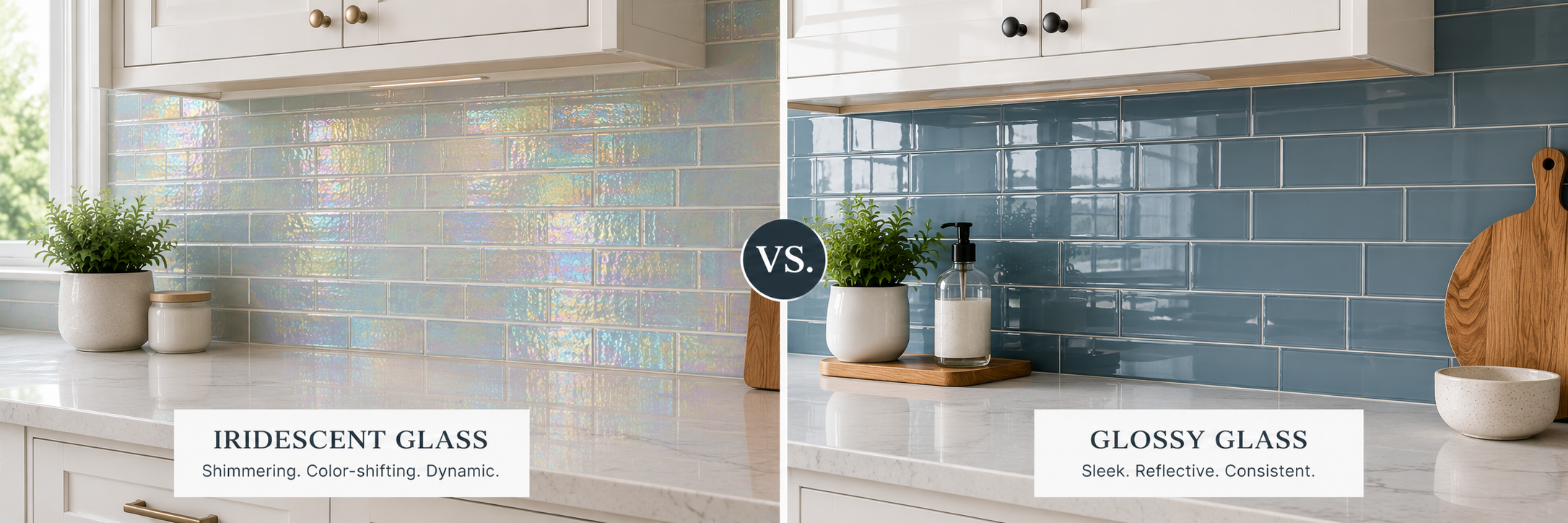
The difference is more than skin deep. Glossy glass tile has a consistent, mirror-like surface that reflects light in a single direction and returns one color — the tile's base color — regardless of how you look at it. Iridescent glass tile adds a thin-film metallic coating that bends and separates light, so the surface appears to contain multiple colors simultaneously. The effect shifts as you move, as the light source changes, and even as time of day changes. Same material. Fundamentally different experience.
This guide compares both finishes across every decision-relevant dimension: how they behave with light, where they work best, how they are maintained, what they cost, and when each one is clearly the stronger choice. If you have already decided on iridescent, our guide to iridescent glass tile backsplash ideas is a useful next step, or head directly to the iridescent glass tile collection. For glossy options, browse our glossy finish tile collection.
How the Two Finishes Are Made
Glossy Glass Tile
Glossy glass tile is produced by firing glass with a smooth, polished face. The manufacturing process creates a dense, reflective surface without any additional coating. The result is a clean, flat shine — the same color at every angle, from every distance, in every light source. The gloss comes from the glass itself rather than any applied treatment, which means it is extremely durable and does not degrade over time with normal cleaning.
Iridescent Glass Tile
Iridescent glass tile starts with the same base glass but receives a thin-film metallic oxide coating during or after the firing process. This coating — similar in principle to the surface of a soap bubble or a compact disc — creates structural color through light interference. Rather than absorbing and reflecting specific pigment wavelengths, the coating refracts white light into its component spectrum, and different wavelengths cancel or reinforce each other depending on the angle of view. The result is a surface whose apparent color is genuinely different from different perspectives. This is not a dye or a print — it is a physical optical phenomenon. For a deeper explanation of how this works, see our complete guide on what iridescent tile is.
Light Behavior: The Most Important Practical Difference
Glossy Tile and Light
A glossy glass tile surface reflects light back in a single direction, creating a clean specular reflection — like a mirror. In a kitchen, this means the backsplash will show a sharp, consistent reflection of the light source directly above or in front of it. The tile looks the same at 8am as it does at 8pm. The reflective quality brightens the room and creates a sense of depth, but the appearance of the tile itself does not change. What you see in the showroom or in the sample is exactly what you will see on the wall every single day.
Iridescent Tile and Light
An iridescent glass tile surface behaves very differently. It is light-activated in a dynamic sense — the tile's appearance genuinely changes with lighting conditions. Morning natural light from a specific angle may emphasize the blue-green spectrum. Afternoon light from another angle may pull out gold or bronze tones. Directional under-cabinet LED strips at night will graze the surface and produce the most saturated, dramatic color shift. Diffuse overhead lighting produces a softer, pearlescent shimmer. The tile you see in a sample held under one light source in one orientation is the starting point of the tile's appearance, not the complete picture. This is a feature, not a limitation — but it means the surface never looks exactly the same twice, which is a fundamentally different experience from a glossy tile.
Where Each Finish Works Best
Glossy Glass Tile: Ideal Applications
Contemporary and Minimalist Kitchens
In kitchens designed around visual restraint — clean lines, minimal hardware, monochromatic palettes — glossy glass tile delivers the reflective quality and brightness of glass without introducing any color variables. The surface is exactly what it appears to be, which suits interiors where predictability and precision are design values. Our glossy finish tile collection includes subway and mosaic formats specifically suited to this application.
Small Spaces Needing Maximum Light Reflection
In very small bathrooms, narrow galley kitchens, or windowless utility spaces, the clean directional reflection of glossy glass tile maximizes perceived brightness more predictably than iridescent tile. When the goal is simply to make the room feel as large and bright as possible without introducing color complexity, glossy white or very light grey glass tile is the most reliable tool.
Commercial Applications
In commercial settings such as restaurant kitchens, retail interiors, or office break rooms, the design brief is often about creating a durable, easy-to-clean, professional-looking surface. Glossy glass tile delivers durability and cleanability in a surface that reads as crisp and intentional without the premium cost or visual complexity of an iridescent finish.
Iridescent Glass Tile: Ideal Applications
Kitchen Backsplashes Where Visual Impact Is the Priority
If the backsplash is intended to be the statement element of the kitchen — the surface that visitors notice and comment on, the reason someone chooses this particular kitchen over another — iridescent glass tile consistently delivers results that glossy tile cannot. The shifting color surface creates a living quality that is genuinely impossible to achieve with a static finish. For specific kitchen scenarios and pairings, see our guide to iridescent glass tile backsplash ideas.
Bathroom Shower Walls and Spa Features
The interaction between iridescent glass tile, steam, and diffused bathroom lighting creates an atmosphere that glossy tile cannot produce. In a shower where the design intention is a spa or retreat experience, iridescent tile elevates the sensory quality of the space beyond what any solid-color finish can achieve. For shower-specific guidance, see our dedicated post on iridescent glass tile shower ideas. Browse our full shower wall tile collection for all relevant options.
Pools and Water Features
The interaction between iridescent glass tile and moving water — activated by sunlight — is one of the most spectacular effects available in residential design. Neither glossy nor matte tile produces anything comparable. If a pool or spa is involved in your project, iridescent glass tile should be on the shortlist. Our iridescent pool tile collection includes products specifically rated for submerged and waterline applications.
Feature Walls and Accent Applications
As a bathroom feature wall, fireplace surround, or living area accent wall, iridescent glass tile creates a surface that genuinely changes throughout the day as ambient light conditions shift. For a feature wall, this dynamic quality is a significant advantage over a static glossy or matte surface. Browse our feature wall tile collection for curated options.
Cost Comparison
Glossy glass tile generally carries a lower per-square-foot cost than iridescent glass tile in comparable formats and qualities. The additional manufacturing step required to apply the thin-film iridescent coating — and the quality controls needed to ensure consistent color-shift performance — accounts for the difference. In practical terms, the premium for iridescent over glossy in standard mosaic formats is modest and well within the normal variation you would see between tile brands and product lines. On larger commercial or full-room projects, the cost difference becomes more material. On a typical kitchen backsplash covering 30 to 50 square feet, the total difference between a glossy and iridescent glass mosaic of comparable quality is unlikely to be a decisive factor in the budget.
Maintenance and Durability
Are They Equally Durable?
In most practical senses, yes. Both glossy and iridescent glass tiles are non-porous, scratch-resistant relative to natural stone, and immune to staining from household cleaning products used as directed. Neither requires sealing. The grout joints in any glass tile installation should be sealed in wet applications, but the tile surface itself needs no special treatment. For both finishes, avoid abrasive scrub pads during cleaning — over time, aggressive scrubbing can dull the surface sheen of either finish.
The Iridescent Coating Over Time
A common question is whether the iridescent coating degrades over time. On quality glass tiles from reputable manufacturers — which is all we carry at Tile Choices — the coating is fused to or within the glass during the manufacturing process rather than applied as a topcoat that can peel or wear. This means the iridescent quality is structural, not cosmetic, and will not diminish with normal cleaning and use. Avoid highly acidic or highly alkaline cleaning agents with either finish, as these can affect both the glass surface and grout joints over time.
Making the Decision: A Practical Framework
Choose Glossy Glass Tile If:
You want a consistent, predictable surface appearance that looks the same in every light condition. Your design aesthetic is minimalist, contemporary, or industrial. You are tiling a commercial or high-traffic space where simplicity and durability are primary requirements. You want a clean reflective quality without color complexity. Budget is a more significant constraint and you need to cover a large area.
Choose Iridescent Glass Tile If:
You want the backsplash, shower wall, or feature surface to be a genuine focal point that draws attention and prompts comment. Your kitchen or bathroom receives varied natural light throughout the day and you want the tile to respond to that variation. The design intention is spa-like, coastal, or jewel-box luxurious. You are tiling a pool interior or waterline where the interaction with moving water and sunlight is part of the design. You want a surface that rewards closer inspection and never looks exactly the same twice. Browse our complete iridescent glass tile collection to see the full range of color options, shapes, and formats available.