
By the Tile Choices Team | Updated April 2026 | 12 min read
Navy blue is the shade of blue that commits. It is not a background color or a subtle accent, when you use navy tile, it becomes the room's defining statement. Done well, it creates the kind of space that feels like it was designed rather than assembled. Done carelessly, it turns a small bathroom into a closet or a kitchen backsplash into a wall of regret. The difference is almost never the shade itself. It is the decisions made around it.
This guide covers navy blue tile ideas across the three applications where it works best, kitchen backsplashes, bathrooms, and pools, with honest advice about what pairs with it, what to avoid, and what you need to know before you order.
What Makes Navy Blue Tile Different from Other Blues
Navy sits at the dark end of the blue spectrum. It absorbs significantly more light than it reflects, which gives it a weight and presence that lighter blues — cobalt, aqua, sky blue — do not carry. In a room with good natural light, that weight reads as sophisticated and intentional. In a room with poor light, it can read as oppressive. This is the single most important thing to understand about navy tile before making any purchasing decision: it is light-dependent in a way that lighter colors are not, and the results in the same tile can be completely different depending on the room.
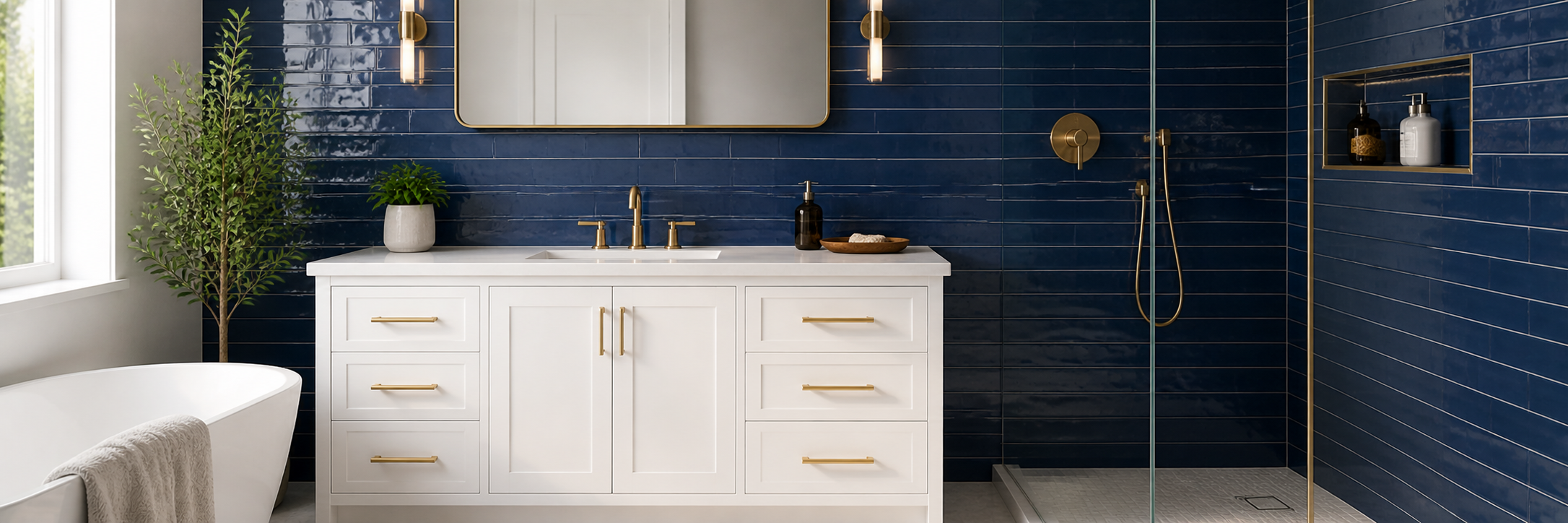
Navy is also unusually compatible with warm metallic hardware — particularly brass and unlacquered brass — in a way that other blues are not. The contrast between warm gold and deep cool navy creates a pairing that interior designers consistently return to because it balances itself naturally. Neither color dominates; each makes the other more vivid. This relationship between navy tile and brass hardware is one of the reasons navy bathrooms and kitchen backsplashes photograph so well and feel so resolved in person.
For a broader look at how navy compares to cobalt, aqua, and other blue shades, read our complete guide to shades of blue tile.
Navy Blue Tile in the Kitchen
The Navy Backsplash
A navy kitchen backsplash is a strong design choice that rewards commitment. The most successful applications treat it as a focal point rather than a field tile — particularly concentrated behind the range where it is framed by cabinetry and the range hood above. Navy glass subway tile in a running bond or vertical stack, running from countertop to hood with white grout, creates an installation that reads as deliberately designed from across the room. The range wall is the right location because the cabinetry on both sides acts like a frame, containing the dark color and preventing it from making the whole kitchen feel heavy.
Navy works especially well in kitchens with abundant natural light. South-facing kitchens with large windows handle navy comfortably because the light counters the color's weight. North-facing kitchens with limited natural light should approach navy more carefully — a full navy backsplash in a dark kitchen can tip from dramatic into oppressive. In those situations, limiting the navy to the range wall and using a lighter tile for the remainder of the run is the more reliable approach.
What to Pair with Navy in the Kitchen
White cabinetry is the most reliable partner for a navy backsplash — the contrast is clean, graphic, and timeless. White or light gray shaker cabinets let the navy do its work without competing. Brass hardware is the strongest fixture choice — cabinet pulls, the range hood, and faucet in brass or unlacquered brass create warmth that stops the kitchen from feeling cold. White marble or quartz countertops complete the combination by adding a reflective light surface at the most visible horizontal plane.
For a full breakdown of design combinations, material options, and how navy fits into the broader range of blue backsplash choices, read our blue tile backsplash ideas guide.
Navy Subway Tile vs. Navy Mosaic in the Kitchen
Navy subway tile is the cleaner, more architectural choice — the rectangular format creates a defined grid pattern that reads as ordered and controlled. Navy glass mosaic is more complex and more organic — the many small pieces catch light at different angles and create a surface that shifts rather than sitting flat. For a kitchen where restraint is the goal, subway tile is right. For a kitchen where the backsplash is meant to be genuinely eye-catching, mosaic delivers more visual reward. Both are available in navy in our kitchen backsplash tile collection.
Navy Blue Tile in the Bathroom
Navy in the Shower
The shower is where navy tile is most at home. The enclosed nature of a shower enclosure is exactly the context in which navy's enveloping quality becomes a feature rather than a concern. Floor-to-ceiling navy on shower walls creates an immersive experience — stepping in feels like entering a different space entirely, calmer and more contained than the rest of the bathroom. Navy elongated subway tile installed vertically heightens the ceiling effect. Navy herringbone on the back shower wall with white field tile on the three surrounding walls gives you the drama of the color without the full commitment.
The shower floor should almost always contrast with navy walls. A white hex mosaic or white penny round floor against navy walls is the most reliable combination — the light floor against dark walls is both visually striking and practically sensible, since it makes the shower floor easier to see. Avoid matching the floor tile to the wall tile in a fully navy shower unless the space is unusually large, because the result can feel more like a tank than a retreat.
Navy on the Bathroom Floor
Navy tile on the bathroom floor with white walls above is an approach with deep roots in early 20th-century American bathroom design. A navy hex floor with white grout creates a honeycomb pattern that reads simultaneously historic and current — it is not a new idea, but it is a genuinely good one. A navy and white penny round basketweave floor is another variation on the same theme. The critical rule with a dark floor is keeping the walls genuinely white, not off-white or cream. The bathroom needs that strong vertical contrast to feel balanced rather than dim.
Navy as a Feature Wall
If the full commitment of an all-navy bathroom or shower feels like too much, a single feature wall is a legitimate starting point. The wall behind the vanity is the most natural location — it is the wall you see most clearly when you enter the bathroom, and it frames the mirror and fixtures in a way that makes the navy feel deliberate rather than random. Large-format navy tile or a navy subway tile grid on that one wall, with white or very light gray on the remaining three walls and ceiling, creates strong visual interest without enclosing the whole room.
For a deeper dive into every aspect of using navy in the bathroom — lighting, grout color, fixtures, what to avoid — read our dedicated guide to navy blue bathroom tile ideas.
Navy Blue Tile in the Pool
What Navy Does to Pool Water Color
This is where navy behaves most differently from how it behaves indoors. In a pool, dark tile at the waterline and on the interior does not make the water look dark in the way you might expect. Instead, navy pool tile makes the water appear a rich, deep teal — the kind of water color associated with natural lagoons and luxury resort pools rather than the bright turquoise of a lighter-tiled residential pool. In full sun, the water above navy tile is genuinely beautiful — deep and vivid, more like the color of the Caribbean than the color of a backyard pool. In shade, it deepens further toward a darker ocean blue.
The trade-off with very dark pool tile is visibility. Darker pool interiors make the pool floor harder to see from above the water, which is a practical safety consideration — particularly relevant for pools used by children or non-swimmers. This is worth discussing with your pool builder before committing to a fully navy interior. Many designers use navy tile at the waterline only, against white or light plaster, which creates the dramatic visual effect without compromising underwater visibility.
Navy at the Waterline
A band of navy glass mosaic at the waterline against white or light gray plaster is a strong combination that creates a clean architectural line around the perimeter of the pool. The contrast between the deep navy tile and the light plaster produces a pool that reads as deliberately designed rather than default. Navy waterline tile works particularly well with contemporary pool shapes — rectangular, geometric, clean-edged — where the dark line emphasizes the pool's structure.
Material Matters: Glass Only for Navy Pool Tile
The material rule for pool tile applies regardless of color. Standard ceramic tile — even high-quality glazed navy ceramic — is not appropriate for constant submersion and chemical exposure. Glass pool tile is the correct material: UV-resistant so the navy will never fade regardless of sun exposure, frost-proof for year-round durability, and non-porous so it resists algae, staining, and chemical damage. Browse our glass pool tile collection for navy and deep blue options rated for aquatic environments. For a full guide to blue pool tile including how tile color affects water color in different conditions, read our blue pool tile ideas guide.
Navy Blue and White: The Classic Combination
Across all three applications — kitchen, bathroom, and pool — navy tile works best when paired with white. The two colors are visual complements in the deepest sense: navy makes white look crisper and more intentional, white makes navy look richer and more deliberate. The combination has centuries of design precedent behind it, from Dutch Delft pottery to Victorian bathroom tile to the classic American pool, which is why it reads as neither trendy nor dated but simply correct.
In the kitchen: navy backsplash, white cabinetry, white countertop. In the bathroom: navy shower walls or floor, white grout, white fixtures and surfaces. In the pool: navy waterline glass tile against white plaster. The same logic applies in every context. For a full exploration of how to use blue and white together across all applications, read our guide to blue and white tile ideas.
Related Reading
- Blue Tile Backsplash Ideas for Kitchens
- Navy Blue Bathroom Tile Ideas: Design Combinations That Work
- Blue Pool Tile Ideas: How Tile Color Affects Your Pool Water
- Shades of Blue Tile: How to Choose Between Navy, Cobalt, Aqua and More
- Blue and White Tile Ideas for Kitchens, Bathrooms and Pools
- Blue Subway Tile Ideas for Kitchens and Bathrooms
Need help choosing? Call us at 614-515-7816 or email sales@tilechoices.com.