Standing in the hardware aisle, or scrolling through an online collection at midnight during a kitchen remodel, and suddenly realizing you have no idea what separates a cup pull from a bar pull from a knob is more common than most homeowners want to admit. Cabinet hardware is one of those details that feels minor until you get it wrong, and then it is the first thing you notice every single time you walk into the room.
This guide breaks down all three hardware types clearly: what they are, what they do best, what kitchen and bath styles they suit, and how to make the final call for your space. If you have already decided that cup pulls are the direction you want to go, you can jump straight to our full cup pulls collection. If you are still deciding, read on.
What Is a Cabinet Knob?
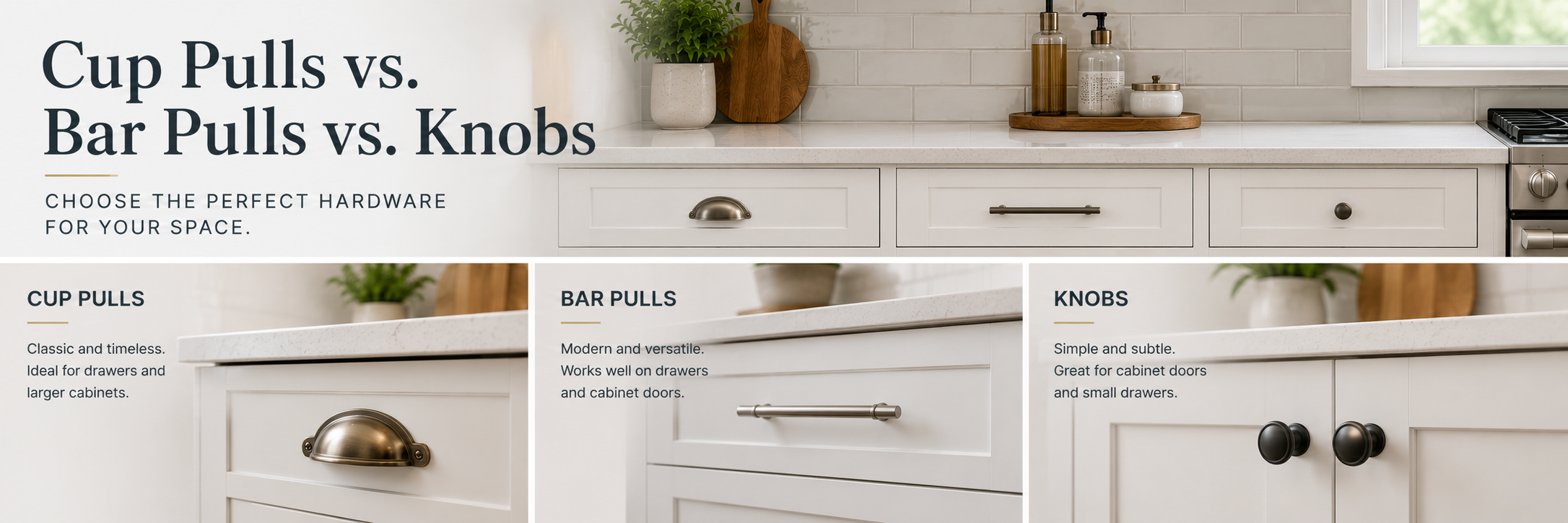
A cabinet knob is the simplest form of cabinet hardware. It is a single-point piece, usually round, square, or geometric, that attaches to a cabinet door or drawer with one screw. Because it uses only one fastener, installation is fast and requires minimal precision. You drill a single hole, thread the screw, and you are done.
Knobs have been used in kitchens and bathrooms for centuries, and their staying power comes from genuine versatility. A simple round knob reads as traditional on a raised-panel door and clean and modern on a flat-front Shaker cabinet. A ceramic or glass knob adds a vintage, artisanal quality. A faceted metal knob can feel almost jewel-like in the right context.
Where knobs work best: cabinet doors, particularly upper cabinet doors, where the motion of opening is a pull-and-swing. The one-point grip is comfortable and intuitive for a swinging door. Where knobs struggle: heavy drawers. A single-point grip on a deep, loaded drawer, pots, pans, baking sheets, puts strain on the wrist and requires more force than a two-point pull. Functionally, knobs are not the best choice for large or heavy drawers, even if they look great elsewhere in the same kitchen.
Browse our full cabinet knobs collection to see the range of profiles, materials, and finishes available.
What Is a Bar Pull (Cabinet Pull)?
A bar pull, also called a cabinet pull or handle, is a piece of hardware with two mounting points and a bar, arch, or bridge spanning between them. It attaches with two screws, one at each end, and is sized by its center-to-center measurement: the distance between those two screw holes. Common center-to-center sizes range from 3 inches up to 18 or 24 inches for large appliance pulls.
The two-point attachment gives a bar pull a significant ergonomic advantage over a knob. You grip the entire bar with your fingers, distributing the pulling force across a wider surface, which makes it much easier to open heavy drawers. This is why professional kitchen designers and cabinetmakers default to pulls, not knobs, for base cabinet drawers, especially in high-use kitchens where those drawers are opened dozens of times a day.
Bar pulls are available in an enormous range of profiles: slim wire pulls with a minimal footprint, arched pulls with a curved bridge, square-edged pulls for a modern geometric look, and substantial appliance pulls for refrigerator panels and dishwasher fronts. If you are designing a contemporary or transitional kitchen, bar pulls are likely what you have seen on the cabinetry that inspired you.
Explore our cabinet pulls collection and our appliance pulls collection for the full range of sizes and finishes.
What Is a Cup Pull — and How Is It Different from Both?
A cup pull is its own category. It is enclosed on one side, the back or top, and open on the other, creating a concave trough or half-moon shape that your fingers slip into naturally from below. Unlike a bar pull, which is open on both ends, the cup pull wraps around your hand. Unlike a knob, it gives you the full two-point grip and ergonomic advantage of a pull.
Cup pulls are also sometimes called bin pulls or drawer pulls, and while manufacturers use those terms slightly differently, they describe the same fundamental form. The shape has deep roots in American hardware history, you would have seen it on general store cabinets, apothecary drawers, and farmhouse kitchens in the late 1800s and early 1900s, which is part of why cup pulls read so naturally in vintage, farmhouse, and traditional design contexts. But they are not limited to those styles. In a matte black finish on flat-front cabinetry, a cup pull is unmistakably modern.
Where cup pulls work best: drawers of all sizes. Their form factor is designed specifically for the horizontal pulling motion of a drawer, and the enclosed top makes the grip feel especially secure. Most designers use cup pulls exclusively on drawers, not on cabinet doors — though there is no hard rule preventing it. You can read more in our cup pulls collection, which covers sizing, finish options, and placement guidance in detail.
Cup Pulls vs. Bar Pulls: The Key Differences
Both cup pulls and bar pulls are two-point drawer hardware, so the comparison between them is more nuanced than cups vs. knobs. Here is where they actually differ:
Visual Weight and Style
A bar pull reads as linear, architectural, and modern. Its horizontal line extends across the drawer face and draws the eye along that axis. This makes bar pulls feel especially at home in contemporary and transitional kitchens where clean geometry is the design language.
A cup pull reads as rounded, compact, and warm. Its shape creates a focal point rather than a line, and that rounded silhouette softens the visual impact in a way that suits farmhouse, traditional, cottage, and transitional kitchens. If your design has natural warmth, wood cabinetry, stone countertops, handmade-style tile, cup pulls often feel more at home than a bar pull would.
Ergonomics
Both provide a two-point grip, but the feel in the hand is different. A bar pull gives you a straight bar to wrap your fingers around. A cup pull lets your fingers cup into the concave shape, which many people find feels more secure, especially when reaching into lower base cabinets where you are pulling at an angle. This is one reason cup pulls are particularly popular for pot drawers and deep base cabinet drawers.
Historical and Design Context
Bar pulls have a more modern lineage, they became common in mid-century and contemporary design. Cup pulls have a much longer history in American homes and carry period-appropriate weight in traditional and historic renovations. If you are renovating a craftsman bungalow, a colonial farmhouse, or a cottage kitchen, cup pulls will feel architecturally correct in a way that a sleek wire pull would not.
How to Choose: A Room-by-Room Decision Framework
Kitchen Drawers
This is the most common hardware decision in a kitchen remodel, and the answer is almost always a pull, either a bar pull or a cup pull, rather than a knob. Knobs on large or heavy drawers are an ergonomic compromise. The question becomes which pull style fits your design direction. For modern and contemporary kitchens, lean toward bar pulls. For farmhouse, traditional, transitional, and cottage kitchens, cup pulls are a natural fit. For shaker-style cabinetry, which bridges multiple styles, either works, and the finish often decides it.
Kitchen Cabinet Doors
Knobs work well on upper cabinet doors where force is minimal and a single grip point is ergonomically comfortable. Bar pulls used vertically on tall cabinet doors are increasingly popular in contemporary kitchens. Cup pulls are less common on doors but not wrong, some designers use them on small spice cabinet doors or pantry doors for a cohesive drawer-to-door look.
Bathroom Vanity
Vanity hardware follows the same logic as kitchen hardware at a smaller scale. A single drawer vanity with one or two drawers often gets a cup pull or a small bar pull on the drawer face and a knob on the door below. For floating vanities with multiple drawers and no doors, a consistent run of cup pulls or bar pulls across all drawers creates a clean, intentional look. Pairing hardware with your bathroom tile finish is a design step most homeowners skip and then wish they had taken, we cover that connection in detail in our post on matching cup pull finishes to your tile.
Mixed Hardware Combinations
Using more than one hardware type in the same kitchen is common, accepted, and often the best design choice, as long as you keep the finish consistent. The most popular combination: cup pulls on drawers, knobs on upper cabinet doors, and a bar pull or appliance pull on tall pantry doors or refrigerator panels. This layered approach lets each hardware type do what it does best while the unified finish holds the look together.
Finish: The Decision That Ties Everything Together
Regardless of whether you choose cup pulls, bar pulls, or knobs, finish is the element that makes or breaks a cohesive hardware scheme. Mixing hardware types is design-forward and intentional. Mixing finishes in the same space without intention reads as unplanned.
Choose one finish for all cabinet hardware within a single space. Then coordinate that finish with your plumbing fixtures, light fixtures, and, critically, the metal tones visible in your tile. A green glass mosaic backsplash has warm undertones that pair naturally with antique brass or unlacquered brass cup pulls. A cool gray porcelain backsplash reads cleaner with brushed nickel or matte black. White subway tile is almost infinitely flexible, it works with every finish, but the grout color you choose will push the hardware reading warm or cool. For a complete breakdown, see our guide on how to match cup pull finishes to your backsplash tile.
You can also browse our kitchen backsplash tile collection to shop tile and hardware decisions side by side.
Ready to Shop?
Explore the full cabinet hardware collection at Tile Choices, including our curated selection of cup pulls, cabinet pulls, cabinet knobs, and appliance pulls. Once you have made your hardware decision, the next step is making sure your finish coordinates with your tile — our guide on matching cup pull finishes to your backsplash walks through that process room by room.