Walk into almost any kitchen showroom or home improvement store and you will find the hardware section both exciting and quietly overwhelming. Dozens of styles, dozens of finishes, and one persistent question that almost every homeowner and designer eventually asks: should I use bar pulls, cabinet knobs, or some combination of the two?
It sounds like a small decision. In practice, it is one of the most visible choices in your entire kitchen or bathroom renovation. Cabinet hardware is at eye level, it is the first thing your hand reaches for every single day, and it has the power to pull a room together or make it feel just slightly off. Getting this right is worth the time it takes to understand the full picture.
This guide covers the functional differences between bar pulls and cabinet knobs, the design logic behind choosing each, how to mix them successfully, and how to match your decision to your cabinet style, finish palette, and renovation goals. Whether you are a homeowner making a first hardware decision or a designer looking for clear language to walk clients through the process, this is the framework that makes the choice straightforward.
What Is a Bar Pull?
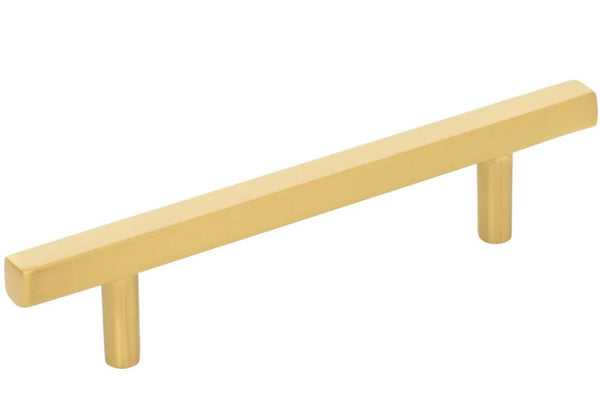
A bar pull is a cabinet hardware piece that spans between two mounting points with a straight, cylindrical or rectangular bar as the grip surface. It attaches to a drawer or cabinet door using two screws, one at each end, and the distance between those two screw holes is called the center-to-center measurement, the critical dimension you use when sizing or replacing a bar pull.
Bar pulls are also called cabinet pulls, drawer pulls, or handle pulls depending on where you encounter them. They come in a wide range of center-to-center sizes, from compact 3-inch pulls suited to smaller drawers all the way up to 18-inch and longer architectural pulls used on pantry doors, appliance panels, and full-height slab cabinet doors.
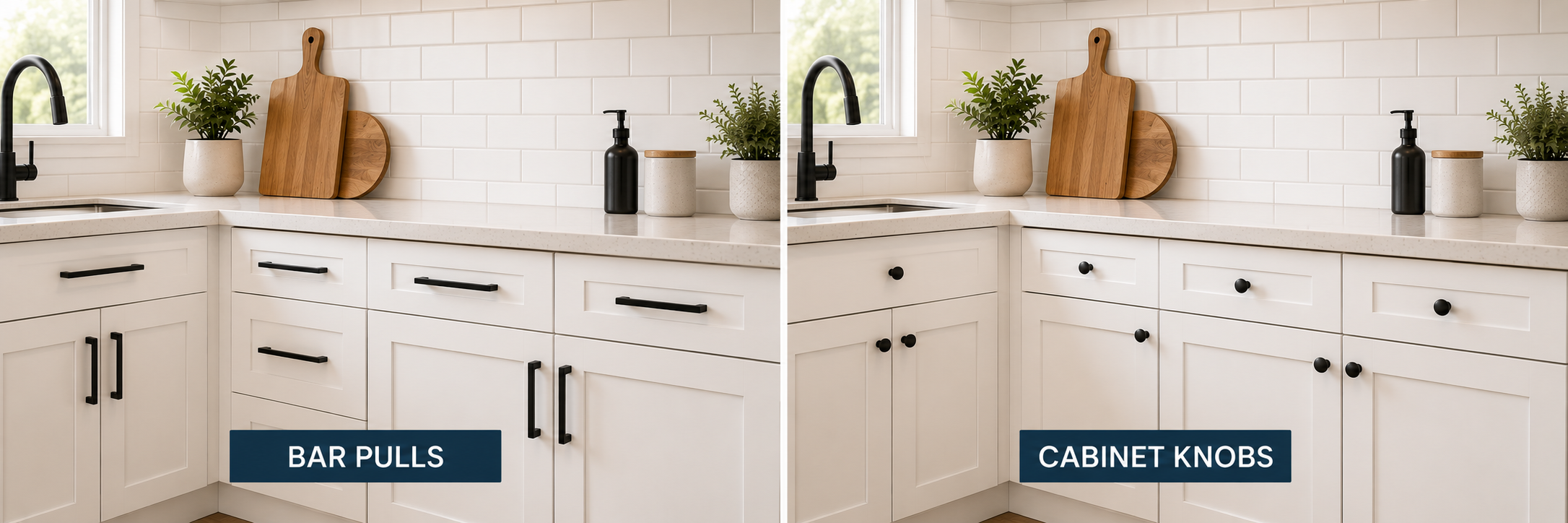
The bar pull's defining quality is its linear geometry. Where a knob is a point of contact, a bar pull is a line, and that line does a specific design job. It reinforces the horizontal or vertical axis of the cabinet face, creates visual rhythm across a run of drawers, and contributes to the clean, uninterrupted look that characterizes contemporary and transitional kitchen design.
You can browse our full range of sizes and finishes in the bar pulls collection at Tile Choices.
What Is a Cabinet Knob?
A cabinet knob is a single-point hardware piece that mounts with one screw through the cabinet door or drawer face. Because it requires only a single hole, it is faster to install than a pull and forgives minor measurement errors more easily. Knobs come in round, oval, square, rectangular, and sculptural profiles in every conceivable finish and material, from simple round brushed nickel spheres to faceted crystal, ceramic, and hammered brass forms.
Knobs have a longer design history in residential cabinetry than bar pulls and carry a slightly more traditional or classic character as a result. A round knob on a raised-panel cabinet door immediately reads as traditional. A square knob on a flat Shaker door reads as transitional. A geometric or faceted knob on a slab door can read as contemporary. The profile and finish together determine the character, not the knob format itself.
From a purely functional standpoint, knobs work best where the grip demand is low. On a hinged cabinet door that swings open, you only need enough grip surface to pull the door toward you, a knob provides exactly that. On a heavy drawer filled with cast iron pans or on a large pantry door that requires real pulling force, a bar pull's longer grip surface provides meaningfully more leverage and comfort.
The Core Functional Difference, and Why It Matters
The practical case for each type of hardware is straightforward once you think about how cabinets and drawers actually open.
A hinged cabinet door pivots on one side. To open it, you apply a brief rotational force, a quick pull toward you from one corner. A knob handles this perfectly. You do not need a long grip surface to swing open a door that is already counterbalanced by its own hinges. A knob provides a compact, comfortable grip for exactly this motion, and because it mounts in a single hole, installation is simple and consistent.
A drawer slides straight out on a horizontal plane. To open it, especially a deep drawer loaded with pots, pans, dishes, or tools, you are pulling dead weight directly toward you. Here, a bar pull has a clear ergonomic advantage. The longer grip surface distributes the pulling force across more of your hand and allows a more natural, full-hand grip, especially important when your hands are wet from cooking or covered in flour. For a wide drawer, a longer bar pull also allows both hands to grip simultaneously, which matters on a full-extension pot drawer or a heavy pantry pull-out.
This functional logic is the origin of the most common hardware recommendation in kitchen design: knobs on doors, bar pulls on drawers. It is not a style rule, it is an ergonomic one, and it happens to look intentional and professional when executed consistently.

When to Use Bar Pulls Only
Using bar pulls on both doors and drawers is a strong contemporary choice and the direction most associated with modern, minimalist kitchen design. When you apply bar pulls consistently across all cabinet surfaces, doors and drawers, the result is a clean, linear, almost architectural finish that lets the cabinetry itself carry the design without competing hardware details.
This approach works best in kitchens with flat-front or Shaker-style cabinet doors where the hardware is the only decorative element on an otherwise plain surface. Long vertical bar pulls on full-height cabinet doors are one of the defining details of high-end contemporary kitchen design right now. A single oversized bar pull spanning nearly the full height of a slab door reads as sculptural and confident in a way that a small knob simply cannot.
For homeowners who want their kitchen to feel clean, modern, and cohesive without the design decision of mixing hardware types, bar pulls throughout is the right call. Choose a consistent center-to-center size across all drawers and a consistent finish throughout, and the result will look considered and purposeful.
Explore the full range of bar pull profiles, sizes, and finishes in our bar pulls collection to find the right option for your space.
When to Use Cabinet Knobs Only
Knobs throughout is the traditional approach and still the right choice for certain kitchen and bathroom styles. In a farmhouse kitchen with raised-panel cabinet doors, a cottage kitchen with inset cabinetry, or a traditional bathroom vanity with furniture-style detailing, knobs carry a character and appropriateness that bar pulls cannot fully replicate. Round or oval knobs in oil-rubbed bronze, antique brass, or polished nickel feel historically grounded in a way that suits ornate millwork and traditional architectural details.
The limitation of knobs-only is functional: on larger or heavier drawers, a single-point knob provides less leverage and a less comfortable grip than a two-point pull. For smaller kitchens with standard-depth drawers and lighter loads, this is rarely an issue. For kitchens with deep base drawers or large pull-outs, knobs alone can feel undersized and slightly awkward to use over time.
Knobs also work beautifully in small bathrooms and powder rooms where the vanity has only doors, no deep drawers, and the goal is a clean, compact look that does not draw too much attention to the hardware.
The Mixed Hardware Approach, Rules for Getting It Right
The mixed approach, bar pulls on drawers, knobs on cabinet doors, is the most popular hardware strategy in kitchen design and the one most recommended by designers and contractors. Used correctly, it feels intentional, professional, and layered. Used carelessly, it looks like you ran out of one type midway through installation and used the other to fill in the gaps. The difference is in three rules.
Rule One: Keep the Finish Identical
This is non-negotiable. If your bar pulls are in brushed gold, your knobs must also be in brushed gold. Not "close to gold", exactly the same finish from the same manufacturer or finish family. A mismatch in finish temperature between two hardware pieces reads as an error, not an intentional choice. Every finish in the cabinet hardware space has a specific undertone, warm, cool, neutral, and mixing undertones within what should be a single cohesive finish looks unresolved. Decide on your finish first, then select both your knobs and pulls from within that finish family.
Rule Two: Share a Design Language Between the Two Pieces
Your knob and your bar pull do not need to be from the same product family, but they should share a geometric or aesthetic vocabulary. A cylindrical bar pull, round in cross-section, smooth, minimal end caps, pairs naturally with a simple round sphere knob. A rectangular flat bar pull with square end caps pairs better with a square or cube-shaped knob. A more architectural, faceted bar pull wants a knob with some geometric edge to it. When the profile language between your two pieces is similar, the combination reads as a designed system. When it is not, it reads as two unrelated hardware decisions placed in the same room.
Rule Three: Scale the Knob to the Door
On a large cabinet door, a 24-inch wide upper cabinet or a tall pantry door, a tiny round knob looks like a button. Scale your knob to the size of the door face. A 1.25-inch to 1.5-inch diameter knob is appropriate for standard upper cabinet doors. On a larger door, a 1.5-inch to 2-inch knob, or a short bar pull used vertically, fills the space better and maintains visual proportion. The same logic applies in reverse: a very small drawer front looks better with a compact 3-inch bar pull than with an oversized 6-inch one.
For the complete hardware selection for your kitchen or bathroom, visit our full cabinet hardware collection where you can compare bar pulls and knobs side by side across every finish.
Matching Hardware Type to Cabinet Style
Shaker Cabinets
Shaker is the most popular cabinet style by a wide margin, and it works equally well with bar pulls, knobs, or a mixed approach. The flat center panel and clean frame give you a neutral backdrop that does not impose a style direction on the hardware. For a modern Shaker kitchen, bar pulls throughout in matte black or brushed gold are the most current direction. For a transitional Shaker kitchen, the classic mixed approach, brushed nickel bar pulls on drawers, simple round knobs on doors, remains consistently effective and timeless. For a traditional Shaker kitchen, oil-rubbed bronze or antique brass knobs with coordinating cup pulls on drawers lean into the historical character of the style.
Flat-Front and Slab Cabinet Doors
Slab doors are the defining cabinet format of contemporary and modern kitchen design. Because a slab door has no frame, no panel, and no millwork detail, the hardware becomes the only visual element on the door face. Bar pulls are strongly preferred here. A long vertical bar pull on a slab door is architecturally confident and visually appropriate in a way that a small knob simply is not, a tiny knob on a large featureless slab door looks like an afterthought. If you are using slab doors, commit to bar pulls and choose a length and profile that is proportional to the door size.
Raised-Panel and Traditional Cabinet Doors
Raised-panel doors carry their own decorative detail, the profile, the shadow lines, the panel geometry all contribute to the visual interest of the door face. In this context, hardware plays a supporting role rather than a starring one. Round or oval knobs in a warm traditional finish suit raised-panel doors naturally. If you use bar pulls on raised-panel doors, choose a profile with some visual weight, a thicker diameter, a more decorative end cap, to hold its own against the door's existing detailing.
How Cabinet Hardware Interacts With Your Tile Choices
One of the most overlooked aspects of hardware selection is how the hardware finish interacts with the tile surfaces in the same room. In a kitchen, your backsplash tile is inches away from your cabinet hardware, the finish temperature, surface quality, and light behavior of the tile and the hardware will either reinforce each other or create a visual tension that makes both look slightly off.
Warm hardware finishes, brushed gold, satin brass, oil-rubbed bronze, pair naturally with warm-toned backsplash tiles. If your backsplash features cream, ivory, warm gray, sage green, or any tile with warm undertones, warm hardware reinforces the palette. Our mosaic tile collection includes glass and stone options in warm, neutral, and cool tones that coordinate across the full range of hardware finishes.
Cool hardware finishes, brushed nickel, polished chrome, stainless, pair naturally with cool-toned tiles. White subway tile, gray stone mosaic, blue glass tile, and crisp white ceramic all sit naturally alongside silver-family hardware finishes. For white bathroom tile applications, see our guide to white bathroom tile ideas for pairing guidance across both tile format and hardware finish.
In kitchens with a green backsplash, one of the most popular tile directions right now, hardware finish selection is particularly impactful. Our green kitchen backsplash tile guide covers how unlacquered brass and brushed gold hardware interact with sage, emerald, and forest green tile shades, with specific examples you can use directly in your planning.
For bathroom renovations pairing new hardware with new tile, our bathroom tile selection guide and our luxury bathroom tile ideas post both include hardware finish context that will help you make coordinated decisions across tile, fixtures, and cabinet hardware in the same planning session.
A Quick Reference: Bar Pulls vs. Cabinet Knobs
Here is a straightforward summary of how bar pulls and cabinet knobs compare across the key decision factors:
Bar pulls mount with two screws, provide a full-hand grip, suit drawers and modern doors particularly well, come in sizes from 3 inches to 24 inches center-to-center, and are the dominant hardware choice in contemporary and transitional kitchen design. They require accurate center-to-center drilling and a hardware template for consistent installation across multiple cabinets.
Cabinet knobs mount with one screw, provide a point-of-contact grip, suit hinged cabinet doors particularly well, install quickly with a single hole, and carry a slightly more traditional or classic character in most profiles. They are forgiving to install but provide less grip surface for heavy drawers.
Mixed hardware bar pulls on drawers, knobs on doors, is the most widely used approach in professionally designed kitchens and works in any style when the finish is consistent and the profiles share a design language.
What to Read Next
Now that you understand the difference between bar pulls and cabinet knobs and have a framework for choosing between them, the next step is getting the sizing right. Bar pulls are sized by center-to-center measurement, the distance between your two mounting holes, and choosing the wrong size is one of the most common and most visible hardware mistakes in kitchen and bathroom renovations.
Our complete sizing guide — How to Choose the Right Bar Pull Size for Your Cabinets — covers the center-to-center system, the one-third rule, standard sizing by drawer width, and the oversized bar pull trend in full detail.
For finish selection, our guide to the best bar pull finishes for every kitchen style covers every major finish from matte black to unlacquered brass with specific pairing guidance for cabinet colors and tile.
When you are ready to install, our step-by-step post on how to install cabinet bar pulls covers tools, templates, drilling technique, and the most common installation mistakes — including the compound measurement error that affects entire cabinet runs when working without a jig.
Ready to shop? Browse the complete selection of bar pulls at Tile Choices, available in every major finish and center-to-center size. Shop bar pulls here. For knobs and coordinating hardware to complete your kitchen or bathroom, visit our full cabinet hardware collection.