Choosing a kitchen backsplash and choosing cabinet hardware are typically treated as separate decisions, one handled by the tile specialist, one handled by the hardware supplier, often at different points in the project. The result in many kitchens is that the two end up working against each other rather than together. A beautiful handmade zellige tile loses some of its warmth when paired with cool brushed nickel hardware. A crisp white subway backsplash looks slightly undecided when the appliance handles are a warm antique gold that nothing else in the kitchen references.
This is the unique advantage that Tile Choices offers: both sides of that decision live in the same place. We carry kitchen backsplash tile and cabinet hardware under one roof, which means you can build a complete, coordinated kitchen palette without the guesswork of matching products across two different retailers. This post is a practical guide to getting that pairing right, specifically, how to choose an appliance handle finish that makes your backsplash tile look its best.
Why Finish and Tile Need to Work Together
Tile and hardware finish are both read simultaneously by anyone standing in the kitchen. They occupy the same visual field, the backsplash runs directly behind the countertop where the hardware lives, and on a refrigerator panel the appliance handle sits in front of whatever cabinetry and tile palette surrounds it. When the finish and tile share the same undertone, both warm, or both cool, the kitchen feels resolved and intentional. When they work against each other, the result is a kitchen that looks almost right but not quite, without most homeowners being able to identify exactly why.
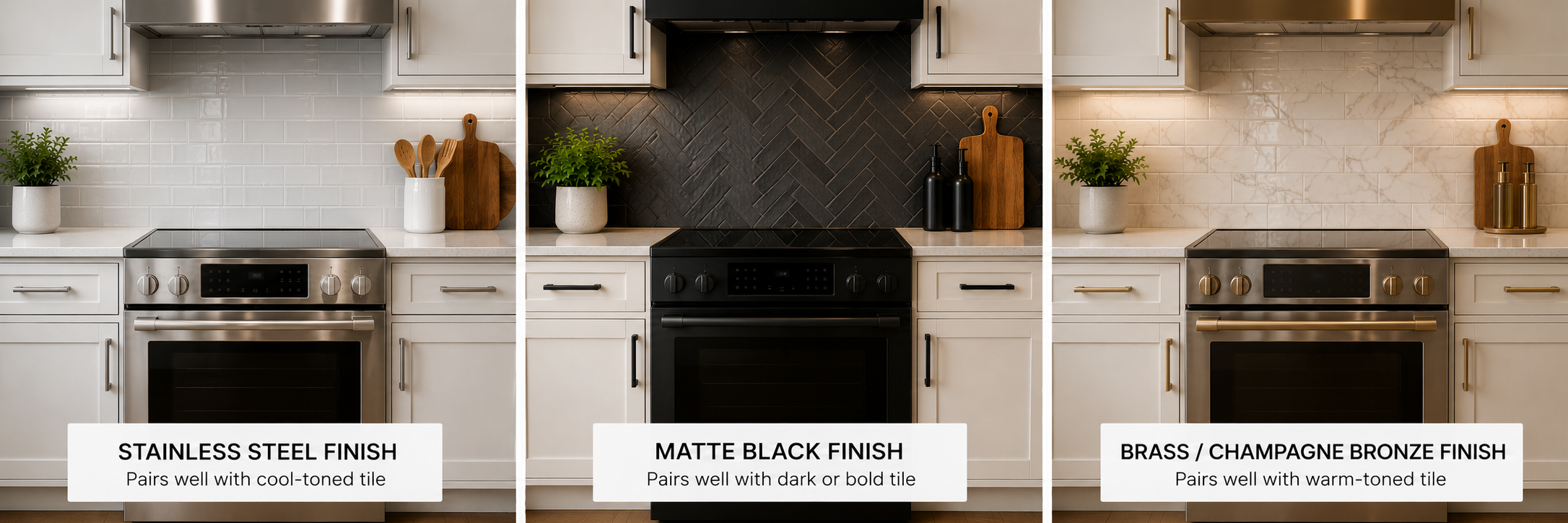
The underlying principle is simple: warm tile tones pair with warm metal finishes, and cool tile tones pair with cool metal finishes. Neutral tiles have flexibility and can go in either direction depending on the secondary design choices. Understanding where your tile sits on this warm-to-cool spectrum is the first step to selecting the right appliance handle finish.
Understanding Warm vs. Cool Undertones in Tile
Every tile has an undertone, a secondary color cast that sits beneath the primary color and influences how the tile reads in a room. Two tiles that are both called white, for example, may read very differently: one may have a blue or gray undertone that makes it feel clean and crisp, while another may have a cream or yellow undertone that makes it feel soft and warm.
Warm-Undertone Tiles
Warm-undertone tiles include cream, ivory, off-white, beige, terracotta, warm gray, caramel, and most natural stone with yellow or pink veining such as honey onyx or warm marble. Handmade and artisan tiles, zellige, encaustic, and hand-painted ceramic, tend to have warm undertones because the clays and glazes used in their production pull naturally warm. Browse our beige tile collection for examples of warm-toned backsplash options.
Cool-Undertone Tiles
Cool-undertone tiles include bright white, blue-gray, charcoal, black, silver, cool green, and most glass tiles. Classic white subway tile with a blue or gray cast, bright white porcelain, and most glass tile formats fall into the cool category. Our white tile and gray tile collections contain both cool and neutral options.
Neutral Tiles
Some tiles read as genuinely neutral, they do not push strongly warm or cool and can work with either metal finish family. True white porcelain, medium gray ceramic, and some natural stones with balanced veining fall into this category. If your tile is neutral, your finish decision gets more latitude, and the choice can be driven by your cabinet color, countertop material, and personal preference rather than the tile alone.
Pairing Guide: Appliance Handle Finishes and Backsplash Tile
Below is a practical pairing guide covering every finish available in the Jeffrey Alexander and Elements collections at Tile Choices. For each finish, this guide covers the tile types and colors it pairs best with, the kitchen styles it suits, and where the pairing breaks down.
Matte Black Appliance Handles
Matte black is the most requested hardware finish in contemporary and transitional kitchens, and for good reason. It creates a strong, graphic contrast that reads as intentional rather than decorative, and it handles fingerprints better than polished finishes, a meaningful benefit on a refrigerator door opened dozens of times a day.
Tile pairings that work especially well with matte black: white and bright off-white tile in any format, gray ceramic in both matte and glossy finishes, charcoal and dark slate tile where the hardware reads as tone-on-tone rather than contrast, and our white subway tile collection in its classic 3x6 format with white or light gray grout. Matte black hardware against white subway tile with dark grout, charcoal or black, is one of the most consistently effective combinations in current kitchen design.
Where matte black struggles: against warm terracotta, honey-toned stone, or golden zellige, matte black can feel harsh and disconnected. In those warm-palette kitchens, satin brass or antique gold will serve the design better.
Brushed Nickel Appliance Handles
Brushed nickel is the most universally versatile finish in residential hardware. It sits in the cool-to-neutral range, reads as understated and refined, and coordinates with stainless steel appliances naturally, which is why it has remained one of the most popular choices in residential kitchens for decades. If you are uncertain which direction to take your finish, brushed nickel is the lowest-risk decision.
Tile pairings that work best with brushed nickel: white subway tile in any format, light gray porcelain and ceramic, cool-toned blue tile including navy and slate blue, green tile with gray-green rather than yellow-green undertones, and most glass tile formats in the blue, gray, and white families. Brushed nickel with light gray grout against a white or pale gray backsplash creates a kitchen that reads as clean, finished, and timeless.
Where brushed nickel struggles: in kitchens built around warm wood tones, cream cabinetry, or terracotta accents, brushed nickel can feel slightly cold and disconnected from the warmth in the rest of the design. Satin brass or antique gold is usually the better finish choice in those kitchens.
Satin Brass Appliance Handles
Satin brass has seen significant and sustained growth in residential kitchen hardware over the past several years as warm, organic kitchen palettes have become a dominant design direction. The finish is warm, slightly muted, and sophisticated, not the shiny brass of the 1980s, but a brushed, toned-down version that reads as contemporary and considered.
Tile pairings that work best with satin brass: cream, ivory, and warm white tile in all formats, terracotta and earthy orange tones, zellige and other handmade tile with warm glazes, natural stone with honey or warm gray veining, warm beige ceramic, and our beige tile collection. Satin brass with cream cabinetry, a warm white zellige backsplash, and natural marble or quartzite countertops is one of the strongest and most cohesive kitchen material combinations in current design.
Where satin brass struggles: in cool-toned kitchens with white or blue-gray tile, stainless steel dominant appliances, or gray cabinetry, satin brass can feel warm to the point of looking out of place. In those kitchens, brushed nickel or matte black is a better finish family.
Antique Gold Appliance Handles
Antique gold is the warmer, more decorative cousin of satin brass. It has more depth and patina, which makes it the right choice for kitchens with a traditional, maximalist, or jewel-toned design direction. It pairs particularly well with marble, especially white marble with warm gray or gold veining, and with rich statement tile colors.
Tile pairings that work best with antique gold: warm white marble, Calacatta and Statuario-style tile formats, deep jewel tones including hunter green and navy in glossy finishes, and tile with visible texture and depth such as handmade zellige or relief-surface ceramics. Browse our gold and yellow tile collection for backsplash options that pair naturally with antique gold hardware. A kitchen with antique gold hardware, deep green cabinetry, and a marble or warm stone backsplash is a combination that reads as genuinely luxurious when executed well.
Where antique gold struggles: in modern, minimalist, or Scandinavian-influenced kitchens where the decorative quality of the finish can feel out of register with the clean, restrained aesthetic.
Oil-Rubbed Bronze Appliance Handles
Oil-rubbed bronze is a warm, darkened finish with a slightly aged quality that suits traditional, rustic, and craftsman kitchen styles. It reads as grounded and earthy, heavier in visual weight than satin brass or antique gold, and appropriate in kitchens where the overall material palette has a natural, organic quality.
Tile pairings that work best with oil-rubbed bronze: natural stone in warm tones including travertine, slate, and limestone, terracotta floor tile used as a backsplash material, brown ceramic, earthy green and tan tile formats, and handmade tiles with irregular edges and warm glazes. In a kitchen with natural wood cabinetry, stone countertops, and an earthy backsplash, oil-rubbed bronze creates a cohesive, warm material story.
Where oil-rubbed bronze struggles: in contemporary or transitional kitchens with clean lines and bright palettes, the heavy, aged quality of oil-rubbed bronze can feel stylistically inconsistent. Matte black serves similar dark-hardware needs in those settings with a cleaner visual result.
Polished Chrome Appliance Handles
Polished chrome is the brightest, most reflective finish available in the hardware collection. It suits high-gloss, modern, and European-influenced kitchen styles where a mirror-finish metal reads as a deliberate design choice rather than a cold one. It is also the closest finish to the polished stainless steel used by most appliance manufacturers, which makes it a natural coordination choice in kitchens where appliance finish consistency is a priority.
Tile pairings that work best with polished chrome: high-gloss white ceramic and porcelain, glass tile in white, silver, and cool gray tones, our glass tile collection in metallic and iridescent finishes, and large-format cool-gray porcelain where the reflective quality of the hardware complements the glossy surface of the tile. Polished chrome in a kitchen with full-height glossy white tile, handleless lower cabinetry, and integrated appliances reads as confidently modern.
Where polished chrome struggles: in warm-palette kitchens and rooms with significant natural wood or earthy tile, polished chrome can feel clinical and disconnected. In those settings, a warm finish family will serve the design better.
Applying the Pairing to Your Specific Kitchen
The pairings above give you the framework; applying them to your specific kitchen requires looking at the complete material palette rather than just the tile and hardware in isolation.
Start With Your Dominant Color
The dominant color in most kitchens is the cabinet color. It covers more surface area than any other single element. If your cabinets are a warm cream, an off-white, or a natural wood tone, you are building a warm palette and your tile and hardware should both support that warmth. If your cabinets are a bright white, gray, navy, or black, you are building a cool or neutral palette and cool-family finishes will feel most natural.
Confirm the Tile Undertone in Your Actual Kitchen Lighting
Tile undertones can shift significantly between showroom lighting and residential kitchen lighting. A tile that reads as a clean neutral white under fluorescent showroom lighting can read warm under incandescent kitchen pendants, or cool under natural north-facing light. Always view tile samples in your actual kitchen lighting before finalizing, and if possible hold a hardware finish sample in the same space. Our kitchen backsplash tile collection includes samples for most products so you can verify undertone in your own kitchen before committing.
Use the Countertop as a Tiebreaker
When your tile reads as neutral and could work with either a warm or cool hardware finish, look to the countertop to make the decision. Warm countertops, butcher block, honey-toned quartzite, warm beige quartz, push the palette toward a warm finish. Cool countertops, white Carrara marble, gray quartz, black granite, push the palette toward a cool or neutral finish.
Match Finish Across All Hardware in the Kitchen
Whatever finish you choose for your appliance handle, it should match the finish on your cabinet pulls, cabinet knobs, and any other hardware in the kitchen. Consistency across all hardware in the same finish is what creates a kitchen that feels resolved rather than assembled from separate decisions. Tile Choices carries all hardware categories within each finish family so you can coordinate everything from the same collection in one order.
Shop Appliance Handles and Backsplash Tile Together at Tile Choices
The advantage of shopping both sides of this decision in one place is that you can see how the tile and hardware finishes relate without translating between different retailers. Browse our full appliance handles collection alongside our kitchen backsplash tile collection to build a palette that works. All cabinet hardware at Tile Choices comes from Hardware Resources and carries a lifetime warranty. Backsplash tile samples are available for most products so you can confirm undertone and finish coordination in your actual kitchen before committing.
For more guidance on sizing your appliance handle before you buy, see our posts on how to choose the right appliance pull size and appliance pulls vs. appliance handles explained. Our team is available at 614-515-7816 or sales@tilechoices.com if you want guidance on your specific project.