Choosing matte black as your cabinet hardware finish is the easy part. The decision that trips most people up comes next: which type of hardware belongs on which cabinet, in which size, placed where? Get it right and the kitchen looks like it was designed by someone who thinks in details. Get it wrong and even beautiful hardware can feel off, a knob that is too small for a wide drawer, a pull that overpowers a narrow door, an appliance pull that does not match anything else in the room.
This guide walks through every hardware type available in matte black, knobs, pulls, bar pulls, cup pulls, and appliance pulls, with specific guidance on where each one works best, how to size it correctly, and how to build a cohesive hardware plan across an entire kitchen. If you are also deciding on tile for the same renovation, see our guide on how matte black hardware pairs with different tile combinations once you have your hardware plan sorted.
Start With the Cabinet, Not the Hardware
The most useful way to approach hardware selection is to think about the cabinets first, what they are, how heavy they are, how often they get used, and then work backward to the hardware type that serves each one best. Different cabinet types have different functional demands, and a hardware choice that ignores those demands will feel wrong to live with no matter how good it looks in a design app.
Most kitchens have four or five distinct cabinet categories: upper cabinet doors, lower cabinet doors, standard drawers, wide or deep drawers, and, if you have panel-ready appliances, appliance fronts. Each category has a hardware type that serves it best, and mapping your kitchen into those categories before you browse is the single most useful thing you can do to simplify the selection process.
Cabinet Knobs: The Right Choice for Doors, the Wrong Choice for Heavy Drawers
Cabinet knobs use a single screw and offer a compact, centered look on a cabinet face. In matte black, they read as a clean punctuation mark, present enough to be noticed, restrained enough not to compete with the cabinet itself. Knobs come in three primary profiles: round, square, and T-knob (sometimes called a mushroom knob), each of which creates a slightly different design register.
Round knobs are the most traditional and work equally well in farmhouse, transitional, and classic kitchens. Square knobs have an edge to them, literally and figuratively, that reads as more contemporary. T-knobs split the difference: the flat top provides a slightly larger grip surface than a standard round knob, which makes them a reasonable choice for upper cabinets where you want the functionality of a pull without the visual weight of one.
Where knobs belong: upper cabinet doors and lower cabinet doors where the contents are light and frequently accessed. Where knobs struggle: wide drawers, deep drawers, and any pull-out that carries real weight. A single-point grip provides less leverage than a two-point pull, and in a high-use kitchen that difference becomes a daily irritation. The functional rule is simple, if the drawer is 24 inches or wider, or if it carries heavy contents, use a pull instead.
Sizing knobs is straightforward. For upper cabinet doors, a knob diameter of 1 to 1.25 inches works in most kitchens. For larger lower doors, 1.25 to 1.5 inches reads better proportionally. Place knobs 2.5 to 3 inches from the bottom edge of the door on upper cabinets, and 2.5 to 3 inches from the top edge on lower cabinets.
Cabinet Pulls: The Modern Default for Drawers and Lower Doors
Cabinet pulls use two screws and provide a longer grip surface, which is what makes them the dominant hardware choice in contemporary kitchen design. A pull requires no pinching. You wrap your hand around it or grip the bar with your fingers, which is significantly more comfortable on any drawer you open dozens of times a day. In matte black, pulls range from slim, minimal bar profiles to more architectural edge pulls and tab pulls, giving you real range in how much visual weight the hardware adds to the cabinet face.
The most critical specification on any pull is the center-to-center measurement, the distance between the centers of the two screw holes. This number determines whether a pull fits your existing holes or, when drilling new ones, where the holes go. It is not the same as the overall length of the pull. A pull may be 6 inches long overall but have a 3.75-inch center-to-center measurement, which means only 3.75-inch-spaced holes will work without drilling new ones.
Common center-to-center measurements are 3 inches, 3.75 inches, 5 inches, 6.25 inches, and 8 inches for standard pulls. Bar pulls run longer, with center-to-center measurements of 8, 10, 12, and 18-plus inches for wide drawer fronts and large lower doors. If you are replacing existing hardware, always measure the center-to-center on what is currently installed before ordering anything new.
For sizing pulls to drawers, the rule of thirds is the most reliable guide: the pull's center-to-center measurement should be roughly one-third of the drawer's total width. A 24-inch wide drawer works best with a pull in the 7- to 8-inch center-to-center range. A 36-inch wide drawer front is better served by a 10- to 12-inch pull. Going significantly smaller makes the pull look lost; going significantly larger can make it look overwhelming.
Bar Pulls: The Cleanest Look in a Modern Kitchen
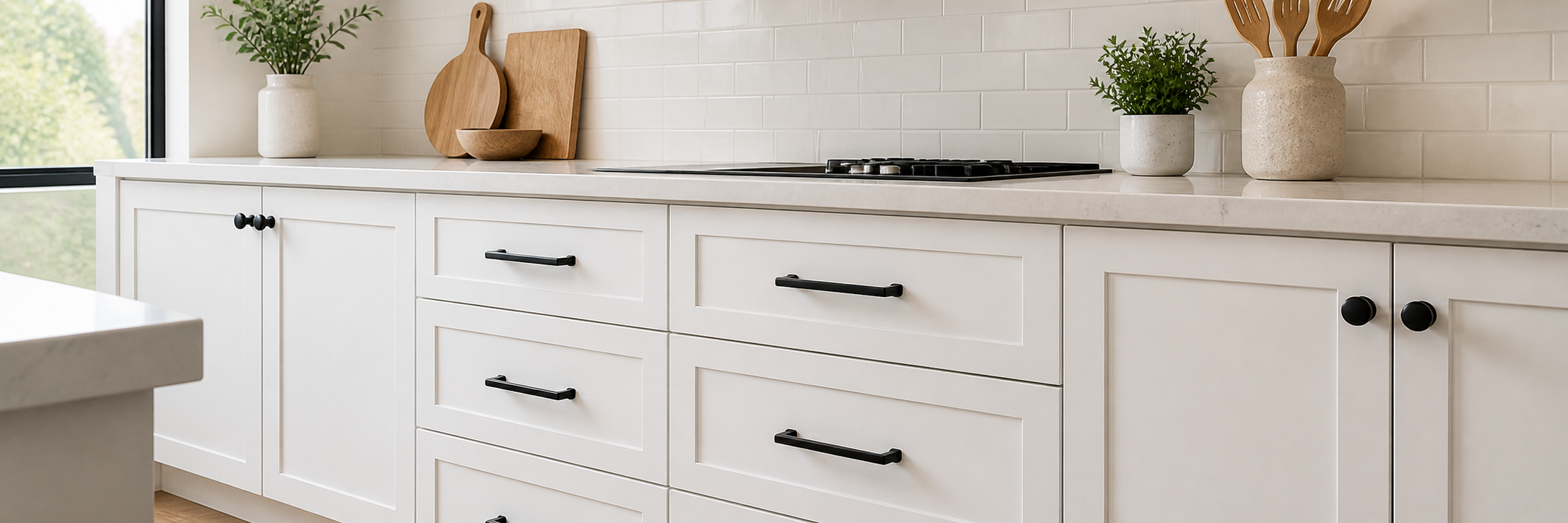
Bar pulls are a specific type of cabinet pull, a straight cylindrical or rectangular rod mounted at both ends. In matte black, a bar pull is one of the most architectural hardware choices available. The clean line of the pull echoes the horizontal geometry of a drawer front and reinforces the modern, minimal aesthetic that flat-front and shaker-style cabinets are designed to create.
Bar pulls are available in lengths from as short as 3 inches to as long as 18-plus inches, which makes them scalable across every cabinet in a kitchen. Many homeowners and designers use the same bar pull profile at different lengths, shorter on upper cabinet doors, longer on wide lower drawers, creating a unified visual system that makes the entire kitchen feel coherent. This approach works especially well in kitchens where the goal is a seamless, handled-by-a-designer look without a large hardware budget.
One consideration with bar pulls is that the longer profiles, anything over 12 inches, can be more demanding on drawer fronts. The pull puts stress on the wood at two narrow points, so drawer boxes need to be solidly constructed to handle daily use without developing any flex around the screw points. In a well-built kitchen this is not an issue, but it is worth noting if you are working with older or builder-grade cabinetry.
Cup Pulls: The Character Choice for Drawers
Cup pulls, also called bin pulls, have a semicircular shape that is gripped from underneath rather than from the front. The grip is entirely different from a bar pull: you reach under the arc and pull upward and outward, which feels natural on a drawer and adds a small but noticeable element of physical satisfaction that bar pulls do not have.
In matte black, cup pulls make a genuine design statement. They have a presence that bar pulls and knobs do not, the arc of the cup creates a shadow line below the pull that adds depth and dimension to an otherwise flat drawer front. This is why cup pulls appear so frequently in farmhouse and transitional kitchens where the goal is warmth and character, but they also work in modern industrial kitchens where the bold, utilitarian shape feels intentional.
Cup pulls are almost exclusively used on drawers rather than doors because the grip geometry does not translate well to a vertical pull motion. They work best on drawers with wider fronts, 18 inches or more, where the arc of the cup reads proportionally. On a narrow 12-inch drawer, a cup pull can look oversized. Standard cup pull center-to-center measurements are 3 inches and 3.75 inches, though larger sizes exist for wider applications.
Appliance Pulls: The Finishing Detail for Integrated Kitchens
If you have panel-ready appliances, refrigerators, dishwashers, or other large-door appliances designed to accept a custom wood panel, you need appliance pulls to complete the installation. An appliance pull is essentially an oversized bar pull, longer and more robustly constructed to handle the weight and frequency of use that a refrigerator or large door demands.
The design principle here is simple but important: the appliance pull should match the cabinet hardware finish. When your refrigerator panel pull is the same matte black as your drawer pulls, the appliance disappears into the cabinetry. The refrigerator no longer reads as a separate appliance element, it becomes part of the cabinet wall. When the appliance pull is a different finish, the appliance stands out as a separate element no matter how good the panel is. This single alignment detail is what separates a kitchen that looks designed from one that looks assembled.
Appliance pulls are typically specified by overall length rather than center-to-center, because the mounting point spacing varies by appliance manufacturer and panel configuration. Measure the mounting point spacing on your specific appliance panel before ordering, or consult the appliance manufacturer's documentation for recommended pull specifications.
Building a Cohesive Hardware Plan for the Whole Kitchen
Once you understand what each hardware type does and where it belongs, building a hardware plan for the entire kitchen becomes much more manageable. Here is a practical framework:
Start with your drawers, since those are the highest-use surfaces and the hardware type matters most functionally. Decide whether you want bar pulls, standard pulls, or cup pulls on your drawers, and choose a center-to-center measurement that works proportionally with your widest drawer. That decision anchors the rest of the plan.
Next, decide whether you want knobs or pulls on your cabinet doors. If you went with bar pulls on the drawers and want a fully modern look, use the same bar pull on doors (vertically mounted) or choose a coordinating pull. If you want a more traditional or transitional feel, a round or square knob on the doors paired with pulls on the drawers is the classic mixed approach. Either works, what matters is that the finish stays consistent.
Finally, if you have panel-ready appliances, confirm the appliance pull finish matches your cabinet hardware and specify it at the same time as the rest of your order so everything arrives together.
Browse the full cabinet hardware collection to see all matte black options organized by type, or use the type subcollection pages to shop knobs, pulls, cup pulls, and appliance pulls individually.